
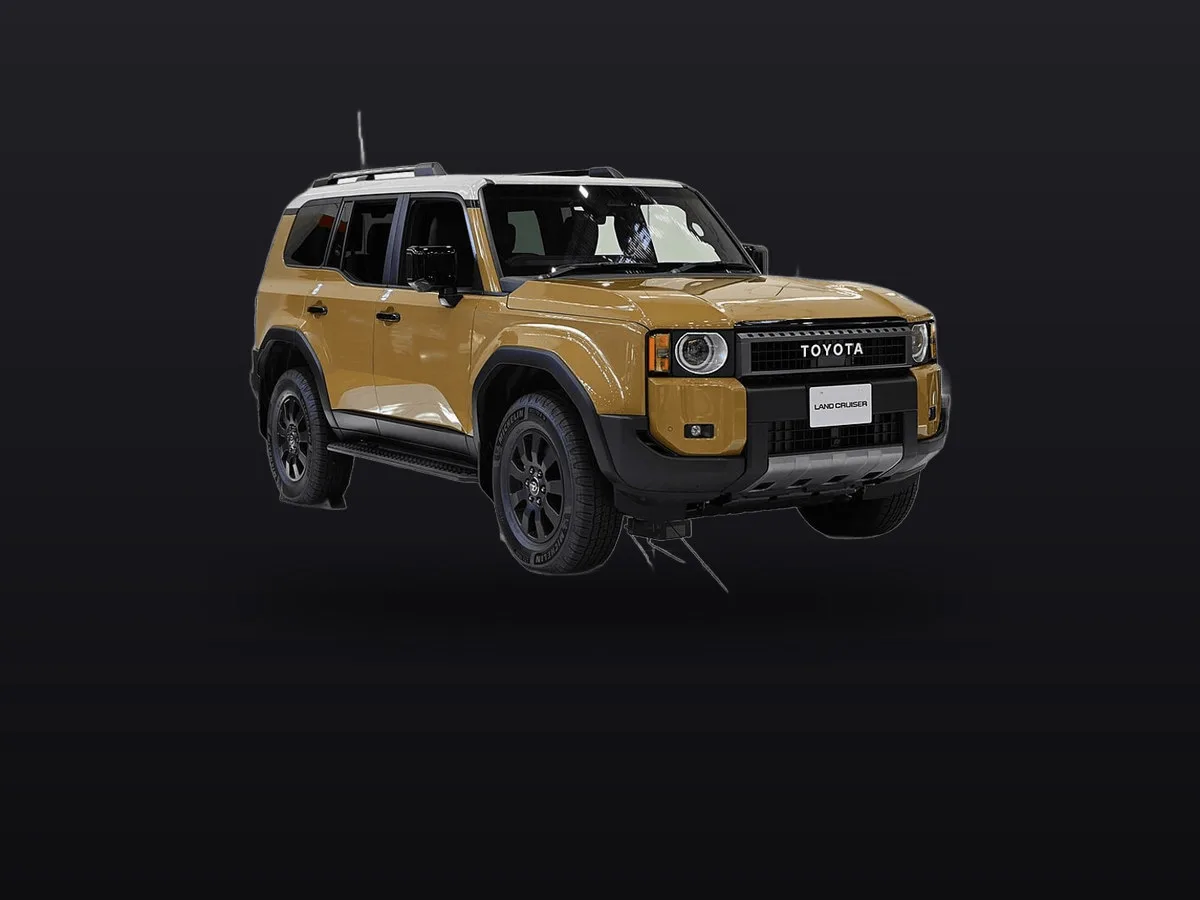
Toyota put the Land Cruiser FJ on sale in Japan on 14 May 2026 at ¥4,500,100 for the single VX grade. Two details in the announcement matter more to an importer than the price does. The car is built at Toyota Motor Thailand’s Ban Pho plant, not in Japan. And Toyota’s launch release names one sales market: Japan.
The short version
- Japan sales began 14 May 2026. One grade, VX, at ¥4,500,100 including consumption tax and excluding recycling fees.
- Powertrain is the 2TR-FE 2.7-litre four-cylinder petrol with a 6 Super ECT automatic, 120 kW (163 PS) and 246 Nm, part-time four-wheel drive.
- Production is at the Ban Pho plant, Toyota Motor Thailand — a Japanese-market Land Cruiser assembled in a source market we buy in.
- At 4,575 mm long on a 2,580 mm wheelbase, this is a compact ladder-frame vehicle, not a scaled-down 300 Series.
- Toyota’s launch release states sales in Japan. It does not announce a wider rollout, and we have not seen one confirmed.
What Toyota actually confirmed
¥4,500,100
Japan price, VX grade
163 PS
120 kW, 246 Nm
8.7 km/L
WLTC combined
| Specification | Land Cruiser FJ VX |
|---|---|
| Engine | 2TR-FE, 2.7-litre inline four-cylinder petrol |
| Transmission | 6 Super ECT automatic |
| Output | 120 kW (163 PS), 246 Nm |
| Drivetrain | Part-time four-wheel drive |
| Fuel economy | 8.7 km/L, WLTC mode |
| Length | 4,575 mm |
| Width | 1,855 mm |
| Wheelbase | 2,580 mm |
| Cargo space | 795 litres, 1,607 litres with rear seats folded |
| Production plant | Ban Pho Plant, Toyota Motor Thailand Co., Ltd. |
From Toyota Motor Corporation's launch announcement. Checked 10 September 2026.
The engine choice is the honest signal about what this vehicle is. The 2TR-FE is a naturally aspirated petrol four that has served in Hilux and Prado applications for years. It is not a performance unit and it was never meant to be. It is a durable, widely understood, easily serviced engine with parts availability in almost every market we ship into — which for a compact ladder-frame off-roader is a more useful property than power.
A Japanese-market Land Cruiser built in Thailand is not a contradiction. It is a routing question, and it is the reason this launch is interesting to an importer.
Built in Thailand, sold in Japan
Toyota lists the production plant as Ban Pho, Toyota Motor Thailand. The car is then sold in Japan as a domestic-market vehicle. That is normal for the IMV family the FJ shares its platform with, and it is worth an importer’s attention for a practical reason: it means two of our seven source markets could, in principle, supply the same car through completely different channels.
We say “in principle” deliberately. Toyota’s announcement names Japan as the sales market. Being assembled in Thailand does not entitle anyone to buy one from a Thai dealer, because a plant builds what its export programme allocates and sells what its distributor lists. Until Toyota announces a Thai or wider Asian availability, the Japanese domestic market is the confirmed route.
Do not assume a plant location means a purchase route
This is a mistake we see monthly. A car assembled in a country is not necessarily a car you can buy in that country, and a car sold in a country is not necessarily one an exporter can freely acquire. Confirm the actual acquisition channel before you promise a customer a delivery date.
What does it land at?
The ¥4,500,100 figure is a Japanese domestic retail price and it includes Japanese consumption tax. Consumption tax is charged at 10%, so the tax component inside that price is roughly ¥409,100, leaving about ¥4,091,000 before it. Whether that tax comes out of an export purchase depends on how the sale is structured and by whom, which is a question for your exporter rather than something we will assert as a general rule.
Converted at the European Central Bank’s euro reference rates for 9 September 2026 — 178.59 yen to the euro, with sterling crossing through 0.85898 — the retail figure looks like this.
¥4,500,100 in other money
ECB euro reference rates, 9 September 2026. Purchase price leg only.
That is a purchase price and nothing more. It carries no ocean freight, no marine cover, no duty, no VAT or GST and no registration tax. In Ireland it would then meet VRT assessed on Revenue’s own open market selling price; in Kenya it would meet a CRSP-derived assessed value; in New Zealand it would meet the Clean Car Standard. The purchase price is the smallest interesting number in this article.
Can you import one?
- It is right-hand drive. A Japanese-market vehicle is right-hand drive as standard, so every right-hand-drive destination on our list is a candidate on that criterion.
- Age bars do not apply to it. A 2026 car is new, so the age limits that govern used imports into Kenya, Sri Lanka and much of the Caribbean are not the obstacle here.
- Emissions and type approval are the real question. A Japanese-market petrol vehicle carries Japanese homologation. Whether your destination accepts that, requires its own certification, or requires an approved-vehicle listing is a country-by-country answer and it is the one to settle first.
- Australia and New Zealand need particular care. Both run structured entry regimes rather than open used imports. Check the applicable register or certification pathway before you commit.
Who it is actually for
A 4,575 mm ladder-frame four-wheel drive with a naturally aspirated 2.7 and 795 litres behind the seats is a working vehicle with a badge people want. That combination sells extremely well in East Africa, the Caribbean and the Pacific, and it competes with the used Prado market rather than with anything new in its own showroom.
For a dealer the interesting comparison is not FJ against a rival. It is a new FJ against a five-year-old Prado landed at a similar figure, which is a genuinely close call and turns almost entirely on how your market taxes new versus used.
On the record
- Japan sales commenced 14 May 2026 at ¥4,500,100 for the VX grade, including consumption tax and excluding recycling fees.
- 2TR-FE 2.7-litre petrol, 6 Super ECT, 120 kW (163 PS), 246 Nm, part-time four-wheel drive, 8.7 km/L WLTC.
- Dimensions of 4,575 mm long, 1,855 mm wide, 2,580 mm wheelbase, with 795 litres of cargo space.
- Production at the Ban Pho Plant, Toyota Motor Thailand Co., Ltd.
Still not established
- Any sales market other than Japan. Toyota’s launch release names Japan and we have not seen a wider rollout confirmed.
- Towing capacity, which Toyota’s launch material does not state in the announcement we read.
- Whether Thai-market availability will follow from the Thai production base. Assembly location is not a sales commitment.
- Right-hand-drive specification differences between any future export markets and the Japanese domestic car.
Move now or wait?
The FJ being built in Thailand rather than Japan also means its supply is subject to Thai export conditions rather than Japanese ones, which are not currently moving in the same direction — see our read on Thai production and export volumes.
Wait, in most cases, and here is the reasoning rather than the verdict. A newly launched Japanese-market vehicle takes time to appear in the auction halls in useful numbers, and the first units through are bought by people paying a launch premium. The used supply that makes an import make sense is a year or more away.
The exception is the buyer who wants a new one and has confirmed their destination will register it. For them the constraint is homologation rather than availability, and that work is worth starting now because it is slower than the shipping.
Specifications and prices are as published by Toyota Motor Corporation for the Japanese market and are subject to change. Exchange rates cited are European Central Bank euro reference rates for 9 September 2026. Import admissibility, emissions certification and tax treatment vary by destination — confirm with the relevant authority before committing funds.
Want a Land Cruiser priced out of Japan or Thailand?
We buy in both markets, inspect before your money moves, and quote one landed figure to your port. Send us the grade, the colour and the destination and we will build the number: start here. Our guide to the best cars to import from Japan covers what actually travels well.
Sources
- Toyota Launches All-New Land Cruiser "FJ" Series in Japan — Toyota Motor Corporation
- New Land Cruiser "FJ" Makes World Premiere — Toyota Motor Corporation
- Euro foreign exchange reference rates — European Central Bank
- Toyota's $28,500 Land Cruiser FJ Matches A RAV4 On Price, Not On Size — Carscoops