
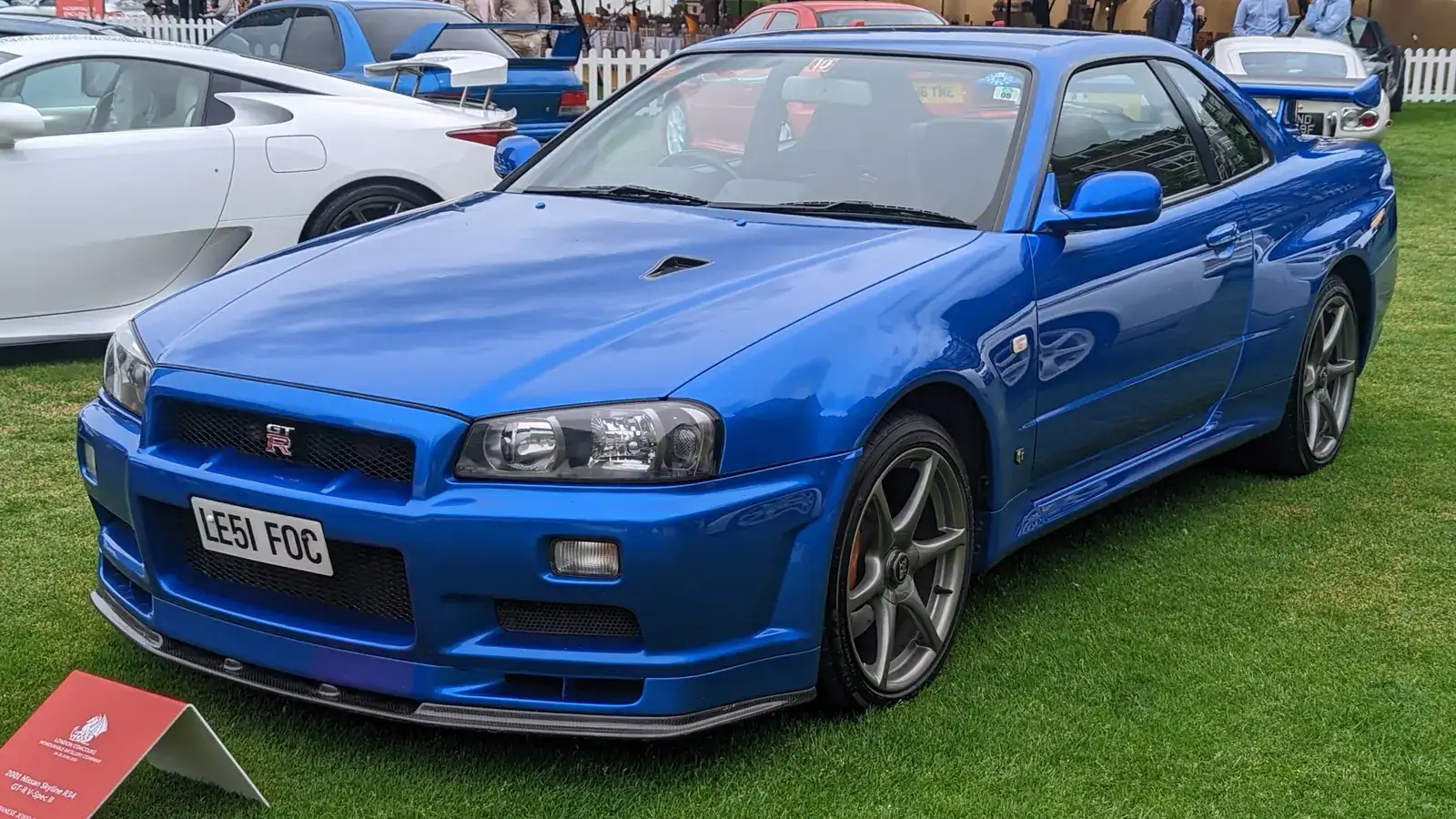
Two identical Japanese cars can land at a UK port on the same vessel and take different roads to a number plate. The eleven-year-old one goes straight to its MOT and the DVLA. The nine-year-old one waits for an inspection slot first. Nothing about the cars differs except the date on their paperwork — which is why the year you choose is a decision about process and tax, not only about mileage.
The short version
- Over 10 years old: no vehicle approval, so no IVA test.
- Under 10: an IVA at £199 in working hours, with the application no sooner than six months after first registration in Japan.
- Any car first used from 1 April 1980 needs a rear fog lamp to pass its MOT — IVA or not.
- 30 years and original: possible collectors’ classification, 0% duty and an effective 5% VAT.
- 40 years and unaltered: no annual MOT; built before 1 January 1986: no vehicle tax from 1 April 2026.
Which years of Japanese car are easiest to import?
Cars over 10 years old are the simplest to register, because GOV.UK exempts cars with up to eight passenger seats from vehicle approval past that age. They still need customs clearance, a NOVA notification, an MOT and DVLA registration. Younger cars need an IVA test first, which adds a fee, a wait and usually some preparation.
Every age line that changes the rules, in one table
| Age line | What changes | Source |
|---|---|---|
| 6 months after first Japanese registration | Earliest IVA application using the Japanese export certificate as evidence (up to 8 passenger seats) | DVSA, 29 Sep 2023 |
| Over 3 years | MOT evidence needed to register | GOV.UK, Vehicle registration |
| Over 10 years | No vehicle approval needed | GOV.UK, Exemptions from vehicle approval |
| First registered before 1 March 2001 | Vehicle tax by engine size | VERA 1994; GOV.UK tax rates |
| First used from 1 April 1980 | Rear fog lamp required at the MOT | MOT inspection manual, 4.5.1 |
| 30 years, original, out of production | May be a collectors' vehicle: 0% duty, 5% effective VAT | UK Tariff, Chapter 97 note |
| Built before 1 January 1986 | No vehicle tax from 1 April 2026 (historic class) | GOV.UK, Historic vehicles |
| Over 40 years, no substantial changes | No annual MOT | GOV.UK, Historic vehicles |
All sources checked 7 October 2026.
Over 10 years old: no IVA, and a quicker registration
GOV.UK’s exemption list is plain: cars and minibuses with eight passenger seats or fewer, not counting the driver, that are over 10 years old do not need vehicle approval. The import guide words the same rule as a car “first registered or manufactured more than 10 years ago”. For a Japanese import that removes the IVA test, its waiting time and the test-specific preparation.
The route for an over-10-year car is short:
- Customs — the import declaration, duty and VAT at the border, made by a customs agent.
- NOVA — HMRC told within 14 days.
- MOT — with a rear fog lamp fitted, because the MOT requires one on any car first used from 1 April 1980 and most Japanese-market cars do not have one.
- DVLA — form V55/5, originals, the £55 fee and the first vehicle tax.
Plan on the date you can prove
A car built in one month and registered in another crosses the 10-year line twice, and the DVLA works from the original foreign registration certificate. Plan on the date that certificate shows, and do not plan an exemption around a car that will only cross the line while it is at sea.
Under 10 years old: what the IVA involves
Individual Vehicle Approval is DVSA’s inspection of how one car is built, for cars that no British or European type approval covers — which includes nearly every Japanese-market car. It is a construction test, not a roadworthiness test, so a sound car can fail it on equipment alone.
| What | The figure | Source |
|---|---|---|
| Inspection fee, normal IVA, working hours | £199 | DVSA fee table, 13 Dec 2022 |
| Re-inspection after a fail | £40 | DVSA fee table |
| Application answered | Usually within 10 working days | GOV.UK, Apply for IVA: cars |
| Inspection offered | Within 20 working days | GOV.UK, Individual vehicle approval |
| Average inspection, normal IVA | 60 minutes | DVSA fee table |
Checked 7 October 2026.
What a Japanese car usually needs before its test
- A rear fog lamp, fitted to the centre or offside — DVSA expects cars from outside the EU not to have one.
- A speedometer that reads in mph. IVA does not accept a km/h-only dial, or a GPS unit in its place.
- Headlamps that dip left — which right-hand-drive Japanese cars already do, so this is rarely the problem it is on a car from a right-hand-traffic country.
Basic or normal IVA
Basic IVA, with lighter evidence, is open to personal imports — but DVSA defines a personal import narrowly: a car imported by someone who has lived in the country of export for at least 12 months and owned and used the car for at least six. A UK resident importing a car from Japan normally takes normal IVA. DVSA does accept a compliant Japanese export certificate as evidence for cars with up to eight passenger seats, which takes much of the paperwork out of it.
The test itself is covered in full in our guide to the IVA test and how to pass an IVA test.
The DVLA registration, step by step
Whichever side of the 10-year line the car is on, registration is the same postal application, and it cannot be made until HMRC has processed the NOVA notification and the duty and VAT are paid.
| What the DVLA needs | When |
|---|---|
| Form V55/5 for a used imported vehicle | Always |
| Proof of vehicle approval (the IVA certificate) | If under 10 years old |
| Evidence of a current MOT | If over 3 years old |
| The original foreign registration certificate — not returned | Always |
| Evidence of the date the car was collected, such as the invoice | Always |
| Photocopy of your photocard driving licence | Always |
| The £55 fee and the first vehicle tax | Always |
Source: GOV.UK, Vehicle registration and Importing vehicles into the UK. Checked 7 October 2026.
Originals only — GOV.UK says not to send photocopies of the vehicle documents. The V5C can take up to six weeks, and you need it to have number plates made. A car whose age or identity is in doubt gets a ‘Q’ registration instead, which is one more reason to keep the export certificate safe. The full sequence is in registering an imported car in the UK.
Nearly new Japanese cars: the six-month rule
DVSA dropped its old requirement that a car be registered in Japan for six months, but kept a timing rule in its place: an IVA application using the Japanese comparable-standards route must be made at least six months after the car’s first registration in Japan. A car imported within weeks of its Japanese registration can therefore arrive before it can be approved.
Road tax deserves a check on a young car too. The CO₂ bands, with their first-year rates, apply only where a car is registered on a certificate stating a CO₂ figure. If a car’s IVA certificate records one, ask the DVLA which table it will apply before you import — it publishes no guidance on imports. How the rate is set is in road tax on a Japanese import.
30 and 40 years: the classic-car lines
30 years: the collectors’ classification
The UK Tariff classes a motor vehicle as a collectors’ piece when it is at least 30 years old, in its original state without substantial changes to the chassis, body, steering, brakes, transmission, suspension or engine, and of a model no longer in production. Modified cars are excluded. A car that qualifies pays 0% duty and an effective 5% VAT. HMRC asks importers to email its Tariff Classification Service before buying.
40 years: MOT and vehicle tax
A car built or first registered more than 40 years ago, with no substantial changes, needs no annual MOT. From 1 April 2026, a car built before 1 January 1986 — or first registered before 8 January 1986 if the build date is unknown — can be taxed at nil in the historic class. It must still be taxed, and kept roadworthy: GOV.UK puts the penalty for a dangerous vehicle at up to £2,500 and three points.
Choosing the year for your budget and your use
| If you want… | Look at | Watch for |
|---|---|---|
| The simplest registration | Over 10 years old | Rear fog lamp for the MOT; ULEZ evidence if you drive in London |
| Low mileage and a newer car | Under 10, with an IVA | IVA prep and wait; the six-month rule if nearly new |
| A modern classic | Around 20–30 years | Parts availability; rust history; insurance |
| A collectors' car | 30+ years, original | HMRC's classification before you import |
Once you know the year you want, you can import a Japanese car for yourself with its age line, approval route and tax position checked before you commit.
Approval, registration, MOT and tax rules on this page were checked on 7 October 2026 against GOV.UK (DVSA, DVLA and HMRC guidance), DVSA’s IVA guidance notes and its bulletin on vehicles imported from Japan, the MOT inspection manual, the UK Integrated Online Tariff and the Vehicle Excise and Registration Act 1994. They change; confirm the position for your car with DVSA or the DVLA before importing, starting at gov.uk/vehicle-approval.