
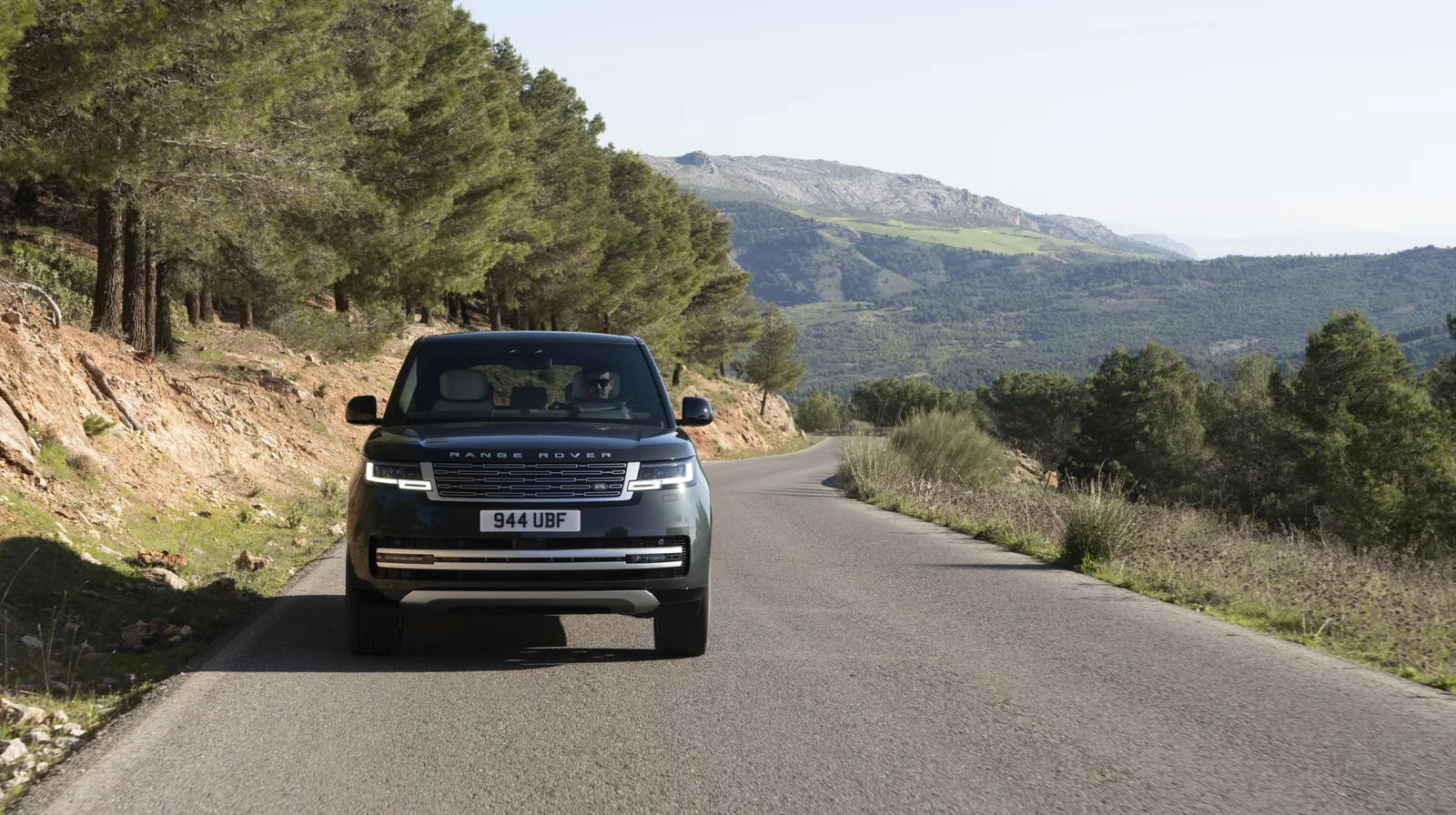
JLR revealed the Range Rover Electric on 2 September 2026 and opened order books the same day. It is the first battery-electric car to wear the Range Rover name in the nameplate’s 56 years: twin 260 kW motors, up to 550PS and 850Nm, a 118.5 kWh usable battery on an 800-volt architecture, up to 372 miles WLTP, and £154,070 OTR in the United Kingdom. It is built at Solihull, which is the part of the announcement that matters most to anyone reading this from outside Britain.
The short version
- £154,070 on the road in the UK, with order books open from 2 September 2026. Standard or long-wheelbase, in SE, HSE, Autobiography, SV, SV Ultra and SV Black, plus a First Edition. Long-wheelbase availability is market-specific on JLR’s own note.
- Twin permanent-magnet 260 kW motors, up to 550PS and 850Nm, 0–60 mph in as little as 4.3 seconds. JLR says it carries more torque than any Range Rover to date.
- 372 miles WLTP, and JLR publishes its own real-world figure of 333 miles alongside it — about 10% below the lab number. Publishing both is unusual and worth crediting.
- It is built at Solihull, on the same line as the combustion and hybrid cars, with battery packs and drive units from JLR’s Wolverhampton plant. For an importer that makes the United Kingdom the source market, not one of several.
- Towing drops to 2,500 kg from the combustion car’s 3,500 kg, on Carscoops’ reporting — JLR published no towing figure. If you tow at the top of the range, this is the specification line that decides it.
What JLR actually confirmed
The release is detailed on engineering and unusually forthcoming on range. JLR gave the battery chemistry and cell count, the charging curve’s headline points, the traction-control response time in milliseconds, and two range figures rather than one.
550PS
Twin 260 kW motors
850Nm
More than any Range Rover to date
118.5 kWh
Usable, 344 prismatic cells
372 mi
WLTP range
900 mm
Wading depth
Solihull
Where it is built
| Measure | Figure |
|---|---|
| Motors | Twin permanent magnet, 260 kW each |
| Power | Up to 550PS (about 542 hp) |
| Torque | 850Nm |
| 0–60 mph | As little as 4.3 seconds |
| 50–75 mph | As little as 2.7 seconds |
| Battery | 118.5 kWh usable, lithium-ion double-stack, 344 cells |
| Architecture | 800-volt, with split charging |
| Range, WLTP | Up to 372 miles |
| Range, JLR's real-world figure | Up to 333 miles (535 km) |
| DC charging | 10–80% in around 22 minutes at 350 kW |
| Charge added in 10 minutes | 137 miles (220 km), WLTP |
| Wading depth | Up to 900 mm |
| Gradient, pull-away | Up to 33 degrees, in Single Pedal mode |
| Gradient, rolling climb | Up to 45 degrees |
| Propulsion warranty | 8 years or 100,000 miles |
Source: JLR, 'Range Rover Electric: A New Era For The Original Luxury SUV', 2 September 2026. JLR notes that WLTP figures are for comparability between models tested under the same conditions and that real-world range varies.
Two engineering claims are worth separating from the marketing around them. Integrated Traction Management controls motor speed within 50 milliseconds and manages slip up to 100 times faster than a combustion equivalent, which is a real consequence of electric propulsion rather than a styling exercise — torque arrives and leaves faster than a driveshaft and a torque converter can arbitrate. Intelligent Driveline Dynamics distributes rear torque from 100% to zero. The 900 mm wading depth and the 45-degree climb are the numbers that tell you JLR did not quietly retire the capability case to make the range figure work.
The superlative, checked
This is the first electric Range Rover. It is not JLR’s first electric car — the Jaguar I-Pace went on sale in 2018, and it is not the group’s first attempt at a battery vehicle. The claim JLR makes is precise and it survives checking; some of the coverage repeating it is not. If you see “JLR’s first EV” today, the writer has lost eight years somewhere.
What £154,070 is, and what it is not
£154,070 is an on-the-road price in the United Kingdom. An OTR price is a domestic retail figure with domestic taxes inside it, and it is not a base for an import calculation in any other country. In the UK that figure carries value added tax at 20%, plus the £55 DVLA first registration fee and the £10 first-year vehicle excise duty a zero-emission car pays when registered on or after 1 April 2025 — both GOV.UK figures, checked 3 September 2026.
Strip those out and the arithmetic is straightforward. The registration fee and the first-year duty sit outside VAT, leaving £154,005 as the VAT-inclusive vehicle price. Divide by 1.2 and the car is £128,337.50 before tax, with £25,667.50 of VAT sitting on top. That VAT figure is the single largest number in this article for anyone buying the car to send somewhere else, and we have set out how it behaves on an export sale in our read on sourcing the car out of the United Kingdom.
A £154,070 OTR price is a British retail number. Roughly £25,700 of it is a tax that a buyer in Nairobi, Auckland or Kingston was never going to pay.
In euros, at the European Central Bank’s reference rate of 0.85870 EUR/GBP on 2 September 2026, £154,070 is about €179,400 and the ex-VAT figure is about €149,500. Those are conversions of a UK price on a single day, not quotes: the rate on the day you actually pay is the one that counts, and the rate your destination’s customs authority applies to your duty is a third number again, usually fixed for a period rather than tracking spot.
A US price of $138,000 before delivery is in circulation, from Carscoops. We have not confirmed that it describes the same specification as the £154,070 UK figure, and a US MSRP excludes sales tax where a UK OTR price includes VAT, so the two are not comparable as published. We are not drawing a conclusion from the gap.
What electric propulsion cost, and what it did not
The honest read on this car is that the capability case survived and the towing case did not, entirely.
JLR published no towing figure. Carscoops reports 2,500 kg against 3,500 kg for the combustion car and 3,000 kg for the plug-in hybrid. Attribute that to Carscoops rather than to JLR until JLR publishes its own. If the number holds, it is a full tonne off the combustion car, and for a specific and not-small group of Range Rover buyers — horseboxes, large twin-axle caravans, plant trailers — that is the whole decision. A 3,500 kg requirement is not a preference you talk someone out of.
Everything else held. 900 mm of wading is the same order as the combustion car. The 45-degree rolling climb and the 33-degree pull-away in Single Pedal mode are capability claims stated in the same terms Land Rover has always used. JLR also says the centre of gravity is lower than the V8’s, which is a genuine structural benefit of putting 118.5 kWh in the floor rather than an engine over the front axle.
What the charging figures mean once you do the division
JLR quotes 10–80% in around 22 minutes on a 350 kW charger. Seventy per cent of a 118.5 kWh usable pack is 82.95 kWh, and 22 minutes is 0.367 of an hour, so the car is averaging about 226 kW across that window. The 350 kW figure is a peak the car touches, not a rate it holds — which is true of every EV and stated plainly by almost none of them. The 800-volt architecture is what makes a 226 kW average possible at all.
The relevant question for an importer is not the peak. It is whether a 350 kW charger exists within range of where the car will live. JLR cites over one million public chargers across the UK and Europe. That sentence does not describe Mombasa, Suva or Port of Spain, and we have taken the charging question apart properly in the sourcing piece.
Does this apply to you, and can you register it?
It applies to you if you buy or sell luxury SUVs into a right-hand-drive market, or into a left-hand-drive market at the luxury end. The Range Rover is sold in 121 countries on JLR’s own figure, in both hands, so this is not a car you have to argue into existence in the correct specification.
On admissibility, three things are in your favour and one is not. It is a new vehicle, so the age limits that govern used imports in Kenya, Sri Lanka and much of the Caribbean do not bite. It is a current model from a manufacturer with an established presence in most of our destination markets, so type approval and parts are not speculative. It is zero-emission, which in several markets attracts a lower duty or excise band than a V8 would.
What is not in your favour is that a battery-electric vehicle is treated as its own category in a growing number of import regimes, and those rules move faster than the rest of the tariff. Sri Lanka, Kenya and several Caribbean authorities have each changed the treatment of electric vehicles inside the last three years. Confirm the current position with the destination authority before you commit money, not after — the Kenya Revenue Authority, NZTA and Customs New Zealand, Sri Lanka Customs, or Revenue in Ireland.
Ireland: the EV relief does not reach this car
Ireland’s VRT relief for electric vehicles is worth up to €5,000 and applies to cars with an open market selling price below €40,000. A Range Rover Electric converts to roughly €179,400 at the European Central Bank’s 2 September 2026 reference rate, so the relief is not in play at any specification, and the relief’s legislated end date of 31 December 2026 is irrelevant to this car. We set out both timetables in our piece on the Irish EV incentive taper. Revenue still assesses VRT on its own valuation rather than on your invoice — the mechanism is in our VRT guide.
What does it land at?
More than the sticker, and less than the sticker plus everything, which is why the number has to be built rather than guessed. A landed cost is the purchase price, inland transport to the port, ocean freight, marine insurance, duty on the CIF value, and consumption tax in the destination — and for this car there is a sixth line most calculators miss, which is whether the UK VAT inside the retail price comes out.
The purchase price is published, which is more than could be said for most launches. That makes this one of the rare new models where a genuine landed figure can be built on day two rather than on the day a price finally appears. What it cannot be built on is a single global number: duty on a passenger vehicle varies from zero to over 100% across our destination list, and several markets assess it on an authority valuation rather than on your invoice.
The UK VAT rate, DVLA first registration fee and first-year vehicle excise duty above are GOV.UK figures, checked 3 September 2026. No duty, excise or registration-tax rate for any destination market is stated in this article, because we have not verified one for this vehicle against the relevant authority. Tax positions change. Confirm the current rate and its treatment with the destination’s revenue or customs authority, or with your broker, before committing money. Providence does not pay import or registration taxes on a customer’s behalf — they are charged to the registered owner.
Should you move now or wait?
2 September 2026
Reveal, and order books open
JLR publishes the full specification and UK pricing, and opens ordering in a choice of standard or long-wheelbase across six specifications plus a First Edition.The next few months
The queue forms in front of you
Every car is built to order at Solihull on a shared line. An order placed later is not merely later in the queue; it is behind however many home-market orders were taken first.Once cars are in the used market
The first residual readings
No electric Range Rover has ever depreciated, so there is no history to price against. The first meaningful data point is a year or more away.
- If you are in the UK and want the car: order it. The price is published, the specification is published, and there is nothing further to learn by waiting except how long the queue got.
- If you are importing it: the useful move now is to fix the specification and the destination and get a landed figure built, because the purchase price exists and most of the rest is knowable. The decision that should not be rushed is charging, covered below.
- If you tow more than 2,500 kg: wait for JLR to publish a towing figure, and if it confirms 2,500 kg, buy the combustion or plug-in hybrid car instead. No amount of range makes a tow rating stretch.
- If you are a dealer: the residual is the exposure, not the purchase. A first-generation electric version of an established nameplate has no depreciation history anywhere, and the battery warranty runs 8 years or 100,000 miles with coverage that JLR says varies by market. Confirm what transfers to a private import in your market before you commit floor-plan, not after.
What is still unknown
On the record
- Every specification figure above, from JLR’s release of 2 September 2026: the twin 260 kW motors, 550PS, 850Nm, the 118.5 kWh usable double-stack battery of 344 prismatic cells, the 800-volt architecture, 372 miles WLTP and 333 miles real-world, 900 mm wading, and the 8-year or 100,000-mile propulsion warranty.
- £154,070 OTR in the United Kingdom, with order books open from 2 September 2026, in standard or long-wheelbase across SE, HSE, Autobiography, SV, SV Ultra and SV Black, plus a First Edition in Belgravia Green, Santorini Black or Varesine Blue.
- Built at Solihull, with battery packs and electric drive units from JLR’s Electric Propulsion Manufacturing Centre at Wolverhampton.
- The first electric car to carry the Range Rover name — verified against the record, and distinct from the Jaguar I-Pace of 2018, which was JLR's first battery-electric vehicle.
Still not established
- Towing capacity. Absent from JLR’s release. The 2,500 kg figure in circulation is Carscoops’ reporting.
- Kerb weight, and payload. Not published, which matters for shipping quotations and for markets that band tax by weight.
- Which markets get the long wheelbase. JLR states only that availability is market-specific.
- Whether the US and UK prices describe the same car. The $138,000 US figure is Carscoops’. We have not matched the specifications, so we draw no conclusion from the difference.
- How the battery warranty behaves on a private import. JLR states 8 years or 100,000 miles with benefits and coverage varying by market, and points at the local retailer. For an imported car in a market with no franchised support, that is a question to answer before purchase.
- Residual values, everywhere. No electric Range Rover has a depreciation history, because none has existed until now.
The one-line version
A private importer or dealer in a right-hand-drive market should read this because the first electric Range Rover is built only in the United Kingdom, at a published price, which makes it a sourcing decision they can cost today.
Costing it against your own port
Our Range Rover Electric page carries the confirmed specification and the six-specification range, so you can register against a specification and a colour rather than a general enquiry. The United Kingdom is one of the seven countries our own team buys in. Tell us where the car is going and we will build the landed figure against your port, with the VAT position and the duty line shown separately — and tell you plainly if the charging answer in your market means you should buy the combustion car instead.
Sources
- Range Rover Electric: A New Era For The Original Luxury SUV — JLR (Range Rover Media Newsroom)
- Range Rover Electric: a new era for the original luxury SUV — JLR
- The electric Range Rover costs $25,000 more than the gas one and tows a ton less — Carscoops
- Vehicle tax for electric, zero and low emission vehicles — GOV.UK
- Vehicle registration: new registrations fee — GOV.UK (DVLA)
- Euro foreign exchange reference rates — European Central Bank