
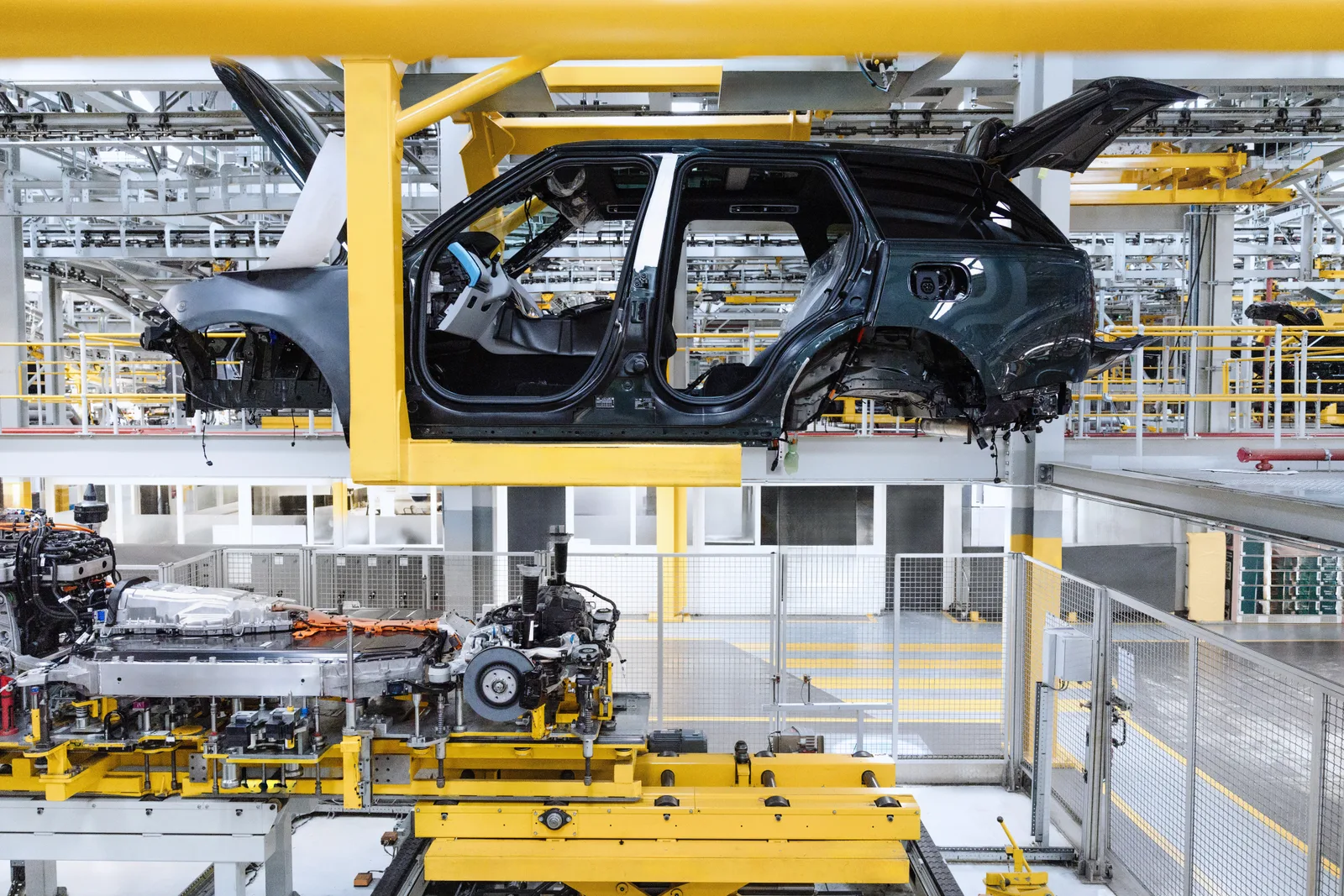
The Range Rover Electric is built in exactly one place: JLR’s Solihull plant in the West Midlands. That makes the United Kingdom the source market for every one of these cars on earth, and it makes the £154,070 UK on-the-road price the number every other market’s price is ultimately derived from. Two things sit inside that figure that an importer needs to understand before doing anything else: about £25,700 of British VAT, and a charging assumption that does not travel.
The short version
- There is no second corridor. Every Range Rover Electric is built at Solihull. You can buy one through another market’s retailer, but you will be buying a British car after somebody else’s taxes and margin have been added to it.
- The £154,070 OTR price contains 20% UK VAT. On HMRC’s conditions an export sale can be zero-rated, which takes roughly £25,700 out of the purchase price before freight and duty are even considered.
- Zero-rating is conditional, not automatic. VAT Notice 703 requires the goods to leave the UK within three months and evidence of export to be obtained and kept within three months. Miss either and the VAT becomes payable.
- A UK-registered example pays £640 a year in vehicle excise duty for five years — the £200 standard rate plus the £440 expensive car supplement, which applies to zero-emission cars listed above £50,000. An exported car never enters that regime.
- The charging question should stop some buyers entirely. A 226 kW average charge rate is worth nothing at a destination with no DC charger. If that describes your market, buy the combustion or plug-in hybrid Range Rover instead.
Why there is only one corridor
Most of what we source has alternatives. A Land Cruiser can be priced out of Japan, the UAE or Australia in the same week, and when one market closes or gets expensive we move to another. That optionality is the thing that usually protects an importer from a bad month.
The Range Rover Electric does not have it. JLR builds it at Solihull, on the same line as the combustion and hybrid cars, with battery packs and electric drive units from its Electric Propulsion Manufacturing Centre at Wolverhampton. Every example in every one of the 121 countries Range Rover sells in starts there.
You can still choose where you buy it. A Dubai or Sydney retailer will sell you the same Solihull car. What you are choosing then is not a different vehicle but a different tax and margin stack on top of it — that market’s import duty, its consumption tax, and its retailer’s margin, all of which you then pay freight on a second time. Buying at the point of manufacture is the shortest version of that chain, and the United Kingdom is one of the seven countries our own team buys in.
For most cars, sourcing is a question of which country. For this one it is a question of how many countries the car passes through before it reaches yours.
The 20% inside the price
A UK on-the-road price is a domestic retail figure and it carries value added tax at 20%. Of the £154,070, the £55 DVLA first registration fee and the £10 first-year vehicle excise duty for a zero-emission car sit outside VAT. That leaves £154,005 as the VAT-inclusive vehicle price, which divides to £128,337.50 before tax and £25,667.50 of VAT.
Stripping UK VAT out of the published price
Our arithmetic on JLR's OTR figure. Fee and duty from GOV.UK, checked 3 September 2026. We assume every element of the OTR price other than the registration fee and first-year duty is VAT-bearing; JLR has published no breakdown.
That VAT is not automatically yours to save. It comes out only where the sale actually qualifies as an export under HMRC’s rules, and those rules have teeth.
What HMRC actually requires
VAT Notice 703 distinguishes a direct export, where the supplier arranges the transport out of the UK, from an indirect export, where an overseas customer or their agent collects the goods in the UK and exports them. Both carry the same deadline: the goods must leave the UK within three months, and valid evidence of export must be obtained and held within three months.
Motor vehicles carry an additional condition. For a direct export the vehicle must not be used or delivered in the UK before it is exported; for an indirect export it must not be used afterwards except for the trip to the place of departure. In plain terms: you do not get to drive it for a fortnight first. Evidence means an export declaration with a departure confirmation and its Movement Reference Number, or commercial transport evidence such as an authenticated bill of lading. If the conditions are not met, HMRC’s position is unambiguous — the supply cannot be zero-rated and VAT is due at the UK rate.
A separate route exists for a private individual who wants to take delivery in Britain and drive the car before leaving. That is the Personal Export Scheme under VAT Notice 707, and it is a different set of conditions: pre-approval on form VAT410 with HMRC’s VAT412 issued before the vehicle may be released, export within 12 months for a qualifying overseas visitor or six months for an entitled UK resident, and an intention to stay abroad with the vehicle for at least six consecutive months. Break the conditions and the VAT you did not pay becomes payable, and the vehicle can be seized.
The VAT, registration-fee and vehicle-excise-duty positions above are HMRC and GOV.UK guidance, checked 3 September 2026 — VAT Notice 703 for exports, VAT Notice 707 for the Personal Export Scheme, and the published vehicle tax rate tables. They describe the United Kingdom only. No duty, excise, consumption tax or registration tax is stated for any destination market, because we have not verified one for this vehicle. Tax rules change and eligibility is fact-specific. Confirm your position with HMRC, your destination’s authority, or a customs broker before committing money. Providence does not pay import or registration taxes on a customer’s behalf — they are charged to the registered owner.
Which way sterling lands
This car is priced in sterling and, for almost everyone reading, that is the source-currency leg of the trade. The rule is the one we apply to every corridor: a weak source currency makes the car cheaper, and a weak destination currency makes everything more expensive, because your own money buys fewer pounds and your duty is assessed on a larger local-currency value at the same time.
The table below converts both the OTR price and the ex-VAT price at the European Central Bank’s euro reference rates for 2 September 2026, with the sterling crosses derived from the published EUR/GBP rate of 0.85870. These are observations on one day, not quotes, and not a forecast — we do not publish views on where a currency is going.
| Currency | At £154,070 OTR | At £128,337.50 ex-VAT |
|---|---|---|
| Euro (EUR) | ≈ €179,400 | ≈ €149,500 |
| US dollar (USD) | ≈ $207,700 | ≈ $173,000 |
| Australian dollar (AUD) | ≈ A$290,600 | ≈ A$242,100 |
| New Zealand dollar (NZD) | ≈ NZ$356,500 | ≈ NZ$296,900 |
Converted from the European Central Bank euro foreign exchange reference rates of 2 September 2026 (EUR/GBP 0.85870, EUR/USD 1.1578, EUR/AUD 1.6199, EUR/NZD 1.9868). Rounded. Conversions of a UK retail price, not landed costs and not quotations.
Two things that table does not show, and both cost people money. The rate on the day you pay is not the rate on the day you were quoted, and on a car at this value a two-point move is more than most people’s freight bill. And the rate your customs authority uses to assess duty is a third number again — most regimes publish a conversion rate fixed for a period rather than tracking spot, so a favourable move this week does not reduce this month’s duty bill. Verify the mechanism for your own destination; it is rarely what people assume.
The question that should stop some buyers
This is the section where the honest answer costs us a sale, so here it is plainly. Do not import this car into a market where you cannot charge it properly.
The specification is excellent on paper. A 118.5 kWh usable pack on an 800-volt architecture takes 10–80% in around 22 minutes on a 350 kW charger, which works out at roughly 226 kW sustained across that window. Every one of those numbers assumes infrastructure. JLR’s own frame of reference is explicit about where that infrastructure is: the release cites over one million public chargers across the UK and Europe, and built-in NACS compatibility for the Tesla Supercharger network in North America. Neither sentence describes most of our destination list.
Settle these four before you ship, not after:
- Is there a DC rapid charger within range of where the car will live, and what does it actually deliver? A 50 kW unit turns that 22-minute claim into something over two hours.
- What DC connector standard does your market use? JLR has not published the connector fitted to a UK-market car, and a mismatch between a European-standard car and a market that standardised elsewhere is not something an adapter reliably solves at 350 kW.
- Will your domestic supply carry a home charger? For a 118.5 kWh pack, home charging is the realistic default and public rapid charging the exception. In markets with constrained or load-shed grid supply this is the binding question, not the car.
- Who services the high-voltage system? The propulsion warranty runs 8 years or 100,000 miles, and JLR states that benefits and coverage vary by market. A battery fault in a market with no trained franchised workshop is a different problem from a battery fault in Surrey.
When the answer is to buy the other car
If the charging answers come back badly, the Range Rover you want is the plug-in hybrid or the combustion car, both built on the same architecture at the same plant and available through the same corridor. That is a genuinely good outcome rather than a consolation — you get the same vehicle, the same build quality and a drivetrain your market can actually support. We would rather tell you that now than land you a car you cannot charge.
The tonne it lost
JLR published no towing figure. Carscoops reports 2,500 kg for the electric car against 3,500 kg for the combustion version and 3,000 kg for the plug-in hybrid. Treat that as trade-press reporting rather than a manufacturer specification until JLR publishes its own.
If it holds, it matters more in our destination markets than it does in Britain. A Range Rover in Kenya, Zimbabwe, Australia or New Zealand is frequently bought to pull something — a horsebox, a stock trailer, a boat — and a full tonne is not a rounding difference. This is a specification line that should be checked against the actual trailer before the order, not after the car lands.
The dealer read
£128,337.50
Ex-VAT vehicle price
3 months
HMRC window to export and evidence it
8 yr / 100k mi
Propulsion warranty, coverage varies
No history
Residual data for an electric Range Rover
The purchase side of this is unusually clean. There is a published price, a single source market, a manufacturer that supports most of our destinations, and a VAT mechanism that is well documented and well-trodden. Compared with sourcing a car whose price does not yet exist, this is an easy unit to cost.
The exposure is entirely on the exit. No electric Range Rover has ever depreciated, because none has existed. Every residual assumption available to you today is either an analogue from another electric luxury SUV or an analogue from a combustion Range Rover, and neither is the same car. At a purchase price north of £128,000 before tax, a residual assumption that is ten points optimistic is more than most dealers’ margin on the unit.
Three practical points for a dealer committing floor-plan. First, every car is built to order at Solihull, so lead time is a queue position rather than a stock decision, and the queue formed on 2 September 2026. Second, confirm what warranty transfers to a privately imported car in your market before you buy, because JLR states coverage varies and an unsupported high-voltage system is a deterrent at resale as well as a risk in service. Third, the battery is the asset — JLR fits a Battery Digital Twin with over 900 diagnostic data points, and a documented state of health will do more for your exit price on this car than mileage will.
Building the actual number
A landed cost for this car is the ex-VAT purchase price, inland transport to the port of loading, ocean freight, marine insurance, duty assessed on the CIF value, and consumption tax in the destination. The first of those is now published, which is why this car can be costed properly on day two rather than in six months.
What we will not do is publish a single landed figure, because there isn’t one. Duty on a passenger vehicle across our destination list runs from zero to over 100%, several markets assess it on an authority valuation rather than your invoice, and a growing number treat battery-electric vehicles as their own tariff category with their own rate. The mechanics of the whole stack, corridor by corridor, are in our guides to importing a car from the UK and what that costs, and the Ireland cost calculator models an Irish landing end to end. The specification itself is on our reveal piece.
On the record
- £154,070 OTR in the United Kingdom, order books open from 2 September 2026, and manufacture at Solihull with battery packs and drive units from Wolverhampton — all from JLR’s release of that date.
- The UK VAT arithmetic above, derived from JLR’s published OTR price and GOV.UK’s £55 registration fee and £10 first-year duty for a zero-emission car, checked 3 September 2026.
- The three-month export and evidence deadlines and the motor-vehicle conditions, from HMRC VAT Notice 703; the Personal Export Scheme conditions from VAT Notice 707. Both checked 3 September 2026.
- The £200 standard rate and £440 expensive car supplement for zero-emission cars listed above £50,000, payable for five years from the second time the vehicle is taxed. GOV.UK vehicle tax rate tables, checked 3 September 2026.
- Currency conversions derived from the European Central Bank's euro reference rates published for 2 September 2026.
Still not established
- Towing capacity. Not published by JLR. The 2,500 kg figure is Carscoops’ reporting.
- The DC connector fitted to a UK-market car. JLR states NACS compatibility for North America and does not specify the UK-market connector in its release.
- Warranty treatment on a privately imported car. JLR states 8 years or 100,000 miles with coverage varying by market, and refers owners to the local retailer.
- Kerb weight. Not published, which affects both freight quotation and any destination that bands tax by weight.
- Any residual value, anywhere. There is no depreciation history for an electric Range Rover, and we will not manufacture one.
- Charging infrastructure counts by destination market. We have not verified charger numbers or standards market by market and are not publishing figures we cannot source.
The one-line version
A dealer or private importer outside Britain should read this because the Range Rover Electric is built only in the United Kingdom, which makes the 20% of its price that is British VAT the largest single variable they can actually control.
Costing the corridor properly
The United Kingdom is one of the seven countries our own team buys in, and this is a car we can quote from the point of manufacture rather than through somebody else’s retail network. Register against a specification and a colour on our Range Rover Electric page, or tell us your destination port and we will build the landed figure with the VAT position, the freight and the duty line shown separately, so you can see which part of the number is doing the damage — including, if the charging answer in your market is the wrong one, the case for not buying it at all.
Sources
- Range Rover Electric: A New Era For The Original Luxury SUV — JLR (Range Rover Media Newsroom)
- VAT on goods exported from the UK (VAT Notice 703) — GOV.UK (HMRC)
- Personal Export Scheme (VAT Notice 707) — GOV.UK (HMRC)
- Vehicle tax rates: cars registered on or after 1 April 2017 — GOV.UK
- Euro foreign exchange reference rates, 2 September 2026 — European Central Bank
- The electric Range Rover costs $25,000 more than the gas one and tows a ton less — Carscoops