
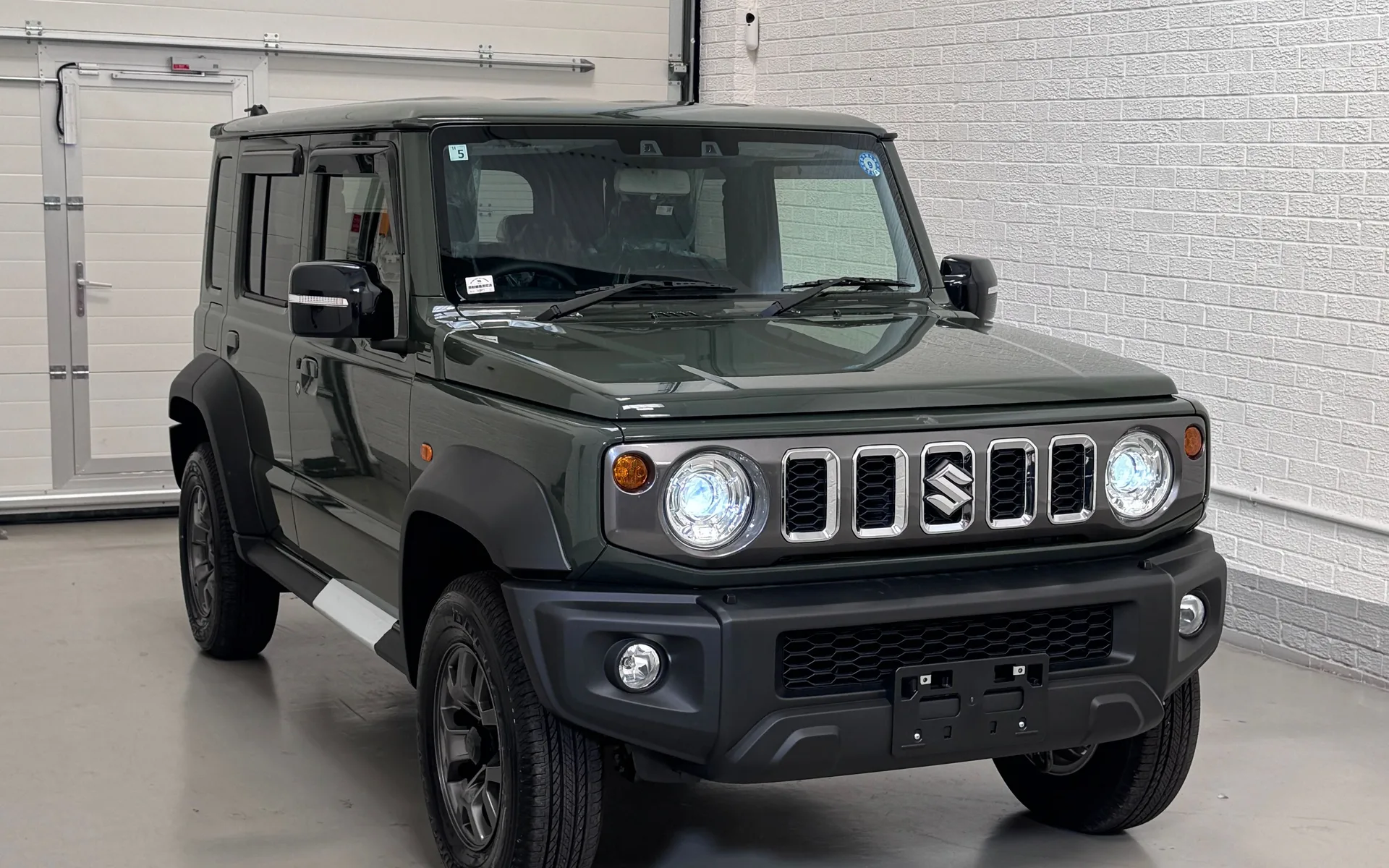
To import a Suzuki Jimny, first decide which Jimny you mean, because there are three and they come from two factories. Suzuki builds the three-door Jimny and Jimny Sierra in Japan. Maruti Suzuki builds the five-door in India. Which factory your car came from decides where you buy it, which documents travel with it and, in some destination markets, how much duty you pay.
The short version
- The three-door is Japanese-built. Suzuki makes the current Jimny and Jimny Sierra at its Kosai plant in Japan, where production began with the July 2018 launch.
- The five-door is Indian-built. Maruti Suzuki builds it at Gurugram and exports it to more than 100 countries — including Japan, where it is sold as the Jimny Nomade.
- All three are right-hand drive in their home markets, which makes Japan and India natural sources for every country that drives on the left.
- Modifications are the commonest trap. Lift kits, oversized tyres and changed bumpers are a registration question in your country, not a cosmetic one.
- Origin can change the duty. Where a trade agreement cuts duty on cars from Japan or India, the car has to be shown to originate there — and a five-door bought in Japan is still an Indian car.
Which Jimny are you actually buying?
Suzuki launched the fourth-generation Jimny in Japan on 5 July 2018, the first all-new Jimny in 20 years. It sells in Japan in two widths, and a five-door followed from India.
| Car | Engine | Doors and seats | Built in | Sold |
|---|---|---|---|---|
| Jimny (kei, chassis JB64) | 0.66-litre R06A turbo three-cylinder | Three doors, four seats | Japan (Kosai) | Japan only |
| Jimny Sierra (chassis JB74) | 1.5-litre K15B four-cylinder | Three doors, four seats | Japan (Kosai) | Japan as the Sierra; export markets as the Jimny |
| Jimny five-door (chassis JC74) | 1.5-litre K15B four-cylinder | Five doors, four seats | India (Gurugram) | India, Japan (as the Jimny Nomade) and export markets |
Sources: Suzuki Motor Corporation launch release, 5 July 2018; Suzuki Jimny Nomade release, 30 January 2025; Maruti Suzuki. Checked 15 October 2026.
The badge on the tailgate does not tell you which of these you are looking at. The chassis code on the registration or export document does. Buy against that code and the vehicle identification number, never against a listing title.
Two factories, two corridors
Suzuki’s 2018 launch release says the new Jimny was the first produced at its Kosai plant, for distribution worldwide. The five-door came later, and from India: Maruti Suzuki reported in October 2025 that cumulative exports of the Jimny five-door from India had passed 100,000 units, with Japan, Mexico, Australia, South Africa and Chile among its largest markets.
Japan is therefore both a factory and an importer of Jimnys. A Jimny Nomade on a Japanese dealer’s forecourt was shipped there from India. For most buyers that is a curiosity. For a buyer whose country cuts duty on Japanese-originating cars, it is the difference between a preferential rate and the standard one.
Japan or India: which source suits you?
Buy in Japan for the three-door, and for used cars
Japan is the only source of the kei Jimny and the deepest used market for the Sierra, with cars sold through dealers and graded at auction. Auction grades, inspection-registration mileage records and a regular roadworthiness inspection give you more evidence about a used Japanese car than most markets offer. Our guide to importing a Suzuki Jimny from Japan goes through the three cars, the prices and the checks.
Buy in India for a new five-door
India is the factory source of the five-door. Maruti Suzuki sells it through its NEXA dealers in Zeta and Alpha variants, each with a five-speed manual or four-speed automatic and four-wheel drive with low range. The Indian specification is not the Japanese one, so compare the exact variant — our guide to importing a Suzuki Jimny from India sets out the differences.
The question to answer first
Does your country drive on the left? Japanese and Indian Jimnys are right-hand drive. In a right-traffic country that is not a bargain to convert; in many of them it is a car that cannot be registered at all.
What to check before you pay
- Modifications. The Jimny is one of the most modified cars in Japan. A lift kit, oversized tyres, a snorkel, a replacement bumper or a roof rack is each a question for your registration authority. Establish what is accepted before you buy, not after the car lands.
- Corrosion. A Japanese research paper from the National Institute for Land and Infrastructure Management records that about 60% of Japan’s land is in snowy regions where chloride de-icing salts are spread. A ladder-frame car is only as good as its chassis rails, so look underneath.
- The four-wheel-drive system. Every current Jimny has a part-time system with a low-range transfer. Confirm it engages in high and low range on the inspection, not just that the lever moves.
- Mileage evidence. A Japanese car’s odometer is recorded at each roadworthiness inspection. A new Indian car has delivery mileage; a used one has whatever its service records show.
- The exact variant. Manual or automatic, which safety systems, which screen. Equipment differs between the Indian and Japanese five-door, and between Japanese grades.
Can it be registered where you live?
Three rules decide it, and none of them is about the Jimny itself.
- Drive side. Covered above. A right-hand-drive Jimny belongs in a left-traffic country.
- Age limits. Several markets cap the age of an imported car. Kenya’s eight-year rule, set by the Kenya Bureau of Standards, is the best known. The current Jimny went on sale in July 2018, so its oldest examples are now past eight years. A newer car clears those limits; check the rule with the authority before you buy.
- Vehicle approval. In markets where the Jimny is not sold new — the United Kingdom is one — registration runs through individual approval. Our guide to importing a Suzuki Jimny to the UK works through the British case in full.
When you know which Jimny and which corridor, you can start your import inquiry and see the car’s landed figure itemised before you commit.
The documents that travel with it
The shape is the same from either country: proof of ownership, the export certificate or customs export clearance, an invoice matching the money actually paid, and a bill of lading. A used car also needs proof it was deregistered in the source country. Some destinations require a pre-shipment inspection in the source country before loading; a car that sails without one can be refused or penalised on arrival.
If your country gives a lower duty rate to cars from Japan or India, the claim also needs proof of origin made out by the exporter. An export certificate proves the car was deregistered; it does not prove where the car was built.
How long it takes
- Finding the car — days for a used three-door in Japan, longer for a specific colour or an unmodified example. A new five-door depends on dealer allocation, which has been tight: Suzuki paused Nomade orders in Japan within days of its January 2025 announcement and reopened them on 30 January 2026, with delivery order decided by lottery.
- Export processing — deregistration, the export certificate and any pre-shipment inspection.
- Sailing — set by the route, not the distance.
- Clearance and registration — the stage with the widest variance, and the one where an approval test or a missing document shows up if it was not planned for.
Duty, consumption tax, registration tax, age limits and approval rules differ by destination and change. Nothing here is a rate or a tax quote for your country. Verify every figure with the revenue, customs or transport authority in your destination before committing.