
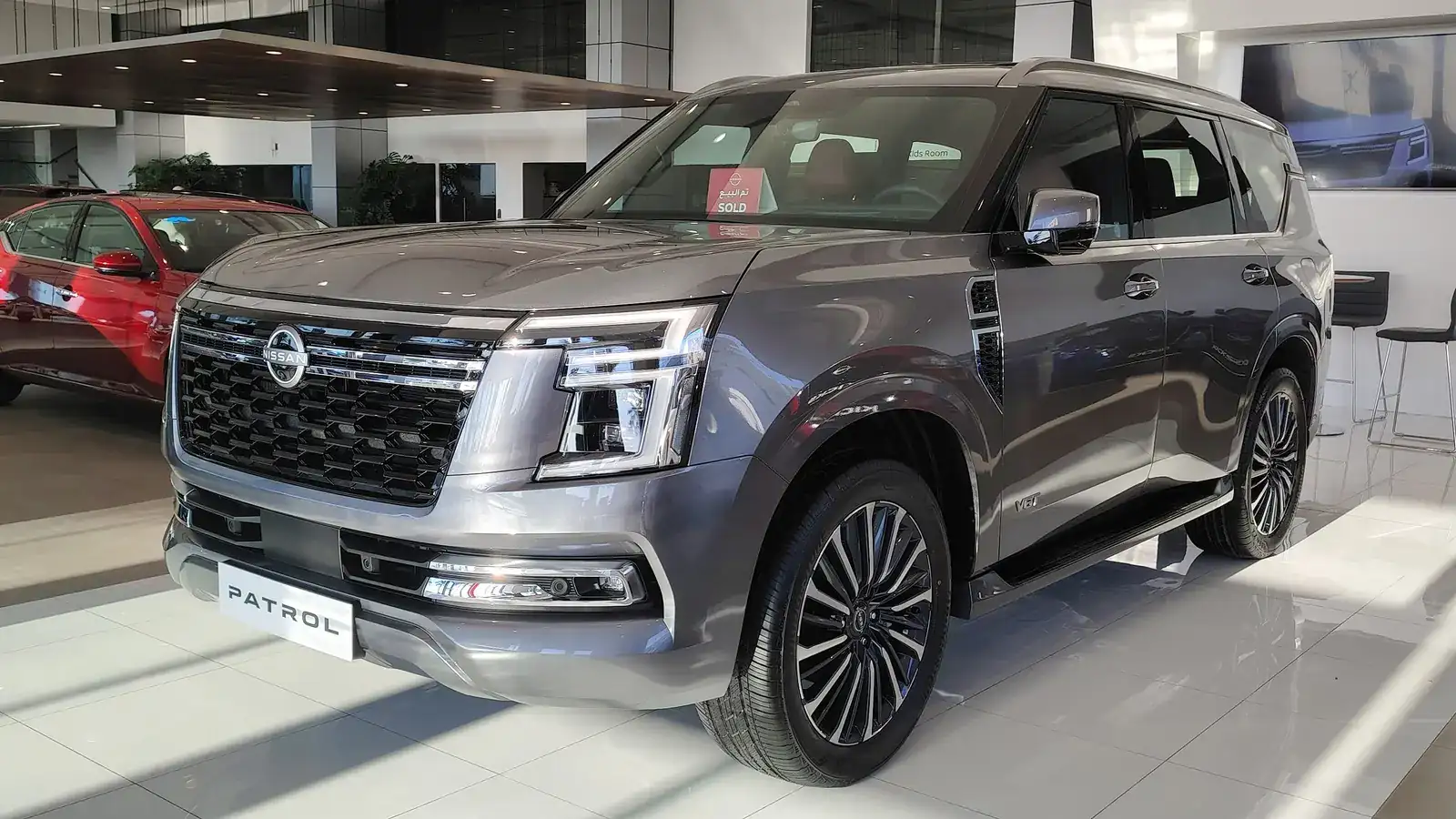
The Nissan Patrol is one of the few vehicles where the hardest part of the import is not the shipping, the paperwork or the tax. It is deciding which Patrol, out of which country. The same nameplate is sold new in left-hand drive in the Gulf, in right-hand drive in Australia and Japan, and not at all in Ireland or the United Kingdom — and those four facts, not the price, decide what your car costs to land.
The short version
- Pick the corridor before the car. Gulf Patrols are left-hand drive; Australian and Japanese ones are right-hand drive. That single choice rules out most of the market for you.
- A new Patrol is not sold in Ireland or the UK, so there is no European type approval to inherit and registration runs through individual vehicle approval.
- Age limits do not bite on a new car, but they govern everything on a used Y61 or Y62 — and they are the rule that most often kills an otherwise good buy.
- The tax on a large petrol V6 or V8 is the whole trade. In CO₂-banded and capacity-banded regimes, the engine costs more than the specification does.
- Modifications are an admissibility question, not a cosmetic one. A bull bar, a lift kit or a long-range tank can each stop a car being registered.
Which Patrol are you actually importing?
Three generations are in active circulation, and they are different propositions rather than different model years.
| Generation | What it is | Who it suits |
|---|---|---|
| Y61 | The older, simpler, live-axle Patrol with a long production run in some markets | Working and remote-area use where parts availability and mechanical simplicity outrank comfort |
| Y62 | The 5.6-litre petrol V8 wagon, sold through 2026 in Australia | Buyers who want a used large SUV with the outgoing V8 and known depreciation |
| Y63 | The current car — a 3.5-litre twin-turbo V6 in most markets, with a 3.8-litre naturally aspirated V6 offered in some | New-car buyers, and dealers stocking a current-shape flagship |
A generational summary, not a specification sheet. Confirm the engine and specification on the individual chassis before agreeing a price — the same badge covers different engines in different markets.
The mistake that costs money here is assuming the badge describes the car. A Y63 imported from the Gulf and a Y63 imported from Australia can differ in engine, cooling, equipment and even seat count. Always import against a chassis number and a specification document, never against a brochure.
The four corridors, and what each one gives you
- Australia. Right-hand drive, English-language service records, a used market full of well-equipped touring cars, and a new car available from franchised dealers. Freight to East Africa and South Asia is longer and less frequent than from Japan.
- Japan. Right-hand drive, the deepest auction system in the world, and an inspection culture that produces a genuinely verifiable condition report. Historically the Patrol was sold there as the Safari, and domestic supply of the current car is recent, so the used pool is thin.
- United Arab Emirates. Left-hand drive, the deepest Patrol market on earth, and the widest choice of high-specification cars. Useful only for a left-hand-drive destination — and the dirham’s dollar peg means the UAE never competes on exchange rate, only on stock.
- United Kingdom. Right-hand drive, but the Patrol has not been a mainstream UK model for many years, so what exists is old, scarce and usually a Y61. Good for a specific project car, poor for volume.
The question to answer first
Does your destination drive on the left or the right? Everything else in this guide is downstream of that answer. A left-hand-drive Patrol in a right-hand-drive market is not a bargain that needs converting — in most of our destination markets it is a car that cannot be registered at all.
What actually makes up the landed cost
The purchase price and the landed cost are different numbers, and on a large petrol SUV the gap between them is wider than on almost anything else. The stack, in the order it is applied:
- Purchase price in the source currency, plus auction or dealer fees, inland transport and export handling.
- Ocean freight and marine insurance, usually invoiced in US dollars. A Patrol is a large, tall vehicle, so it is expensive on both containerised and roll-on roll-off freight.
- Customs duty, almost always assessed on the CIF value rather than what you paid.
- Consumption tax — VAT or GST — typically charged on the duty-inclusive value, so duty is taxed too.
- Excise or luxury tax, often banded by engine capacity or by price. This is where a 3.5 or 5.6-litre Patrol is punished hardest.
- Registration tax, where the market has one. Ireland’s VRT is the archetype: a CO₂-banded percentage of Revenue’s own valuation, plus a NOx levy — the mechanism our VRT guide sets out in full.
- Levies and fees — inspection, import declaration, development and railway levies, port charges, registration and plates.
Two things about this stack catch importers out repeatedly. The first is that in several markets the tax base is the authority’s own assessed value rather than your invoice, so a low purchase price does not reduce the tax proportionally. The second is that duty and tax are converted at your customs authority’s published rate, which is usually fixed for a period rather than tracking the rate on your banking app. You can model an Irish landing end to end with the Ireland cost calculator.
Why the engine is the expensive decision
On a Patrol, the specification you choose changes the price by tens of thousands. The engine changes the tax by more than that in some markets, every year, for as long as you own the car.
A large petrol V6 or V8 sits at or near the top of every CO₂ band and every engine-capacity band that exists. In a capacity-banded excise regime, a few hundred cubic centimetres either side of a threshold can cost more than moving up two grades. In a CO₂-banded registration tax, the figure that decides your band is the one on the vehicle’s Certificate of Conformity — not a brochure figure, not a road-test figure, and not the figure the same nameplate carried three years ago.
Get that document, in writing, for the actual chassis, before you agree a price. If nobody can produce it, you do not have a quote — you have an estimate with a decimal point in it.
Can the car be registered where you live?
Age limits
Several destination markets cap the age of an imported vehicle, and the rule is a hard gate that no amount of condition or specification overrides. Kenya’s eight-year rule is the best known of them, set through the Kenya Bureau of Standards and enforced at import. A new Patrol clears every age limit by definition; a used Y62 may not, depending on the year and the market. Confirm the current position with the standards and revenue authorities in your destination before you bid, not with a forum thread.
Type approval and individual approval
In Ireland and the United Kingdom the Patrol is not a current model, so there is no European or UK type approval attached to the car. Registering one means an individual approval: in Ireland, an NSAI Individual Vehicle Approval assessed against Irish legislation and inspected at an approved test centre, and Revenue will not register a new vehicle without a valid Certificate of Conformity, an EU IVA or an Irish national IVA. It is a real process with a real failure rate, and it is the part of a European Patrol import that goes wrong — not the shipping.
Modifications
Patrols attract equipment. Bull bars, lift kits, long-range tanks, aftermarket seats, roof racks, snorkels, dual battery systems and winches are common on Australian cars in particular, and every one of them is a registration question in the destination market. Some are accepted, some require engineering certification, and some must be removed before shipment. Establish which before you import, not after the car lands — our guide to importing a ute or 4x4 from Australia covers how we check this.
The documents that have to travel with it
The exact set depends on the source country, but the shape is constant: proof of ownership and de-registration in the source market, an export certificate, an invoice that matches the money actually paid, a bill of lading, and any pre-shipment inspection certificate the destination requires. We keep a per-country breakdown of exactly what is issued and what it looks like:
- Australian export documents explained
- Japanese export documents explained
- UAE export documents explained
Pre-shipment inspection is the one that catches people. Several markets require an inspection carried out in the source country before loading, by an appointed agency. A car that sails without it can be refused or heavily penalised on arrival, and no amount of paperwork afterwards fixes it.
How long it takes
Plan in stages rather than in a single number, because the stage that slips is rarely the sailing.
- Sourcing — days for a new car with an allocation, weeks for a specific used specification at auction.
- Export processing — de-registration, export certificate and inspection, typically one to three weeks.
- Sailing — weeks, and the schedule depends far more on the route than the distance. Japan to East Africa is better served than Australia to East Africa.
- Clearance and registration — the widest variance of all, and the stage where an approval or inspection requirement becomes visible if it was not planned for.
For a new Patrol there is a fifth stage before all of these: the manufacturer’s own delivery queue. A car that has not been built cannot be shipped, and order-to-delivery on a newly launched flagship is measured in quarters.
Import duty, consumption tax, excise, registration tax and age limits differ by destination and change — often at budget time. Nothing here is a rate, a threshold or a tax quote. Verify every figure with the revenue or customs authority in your destination market before committing, and treat any number that does not cite one as an estimate.