
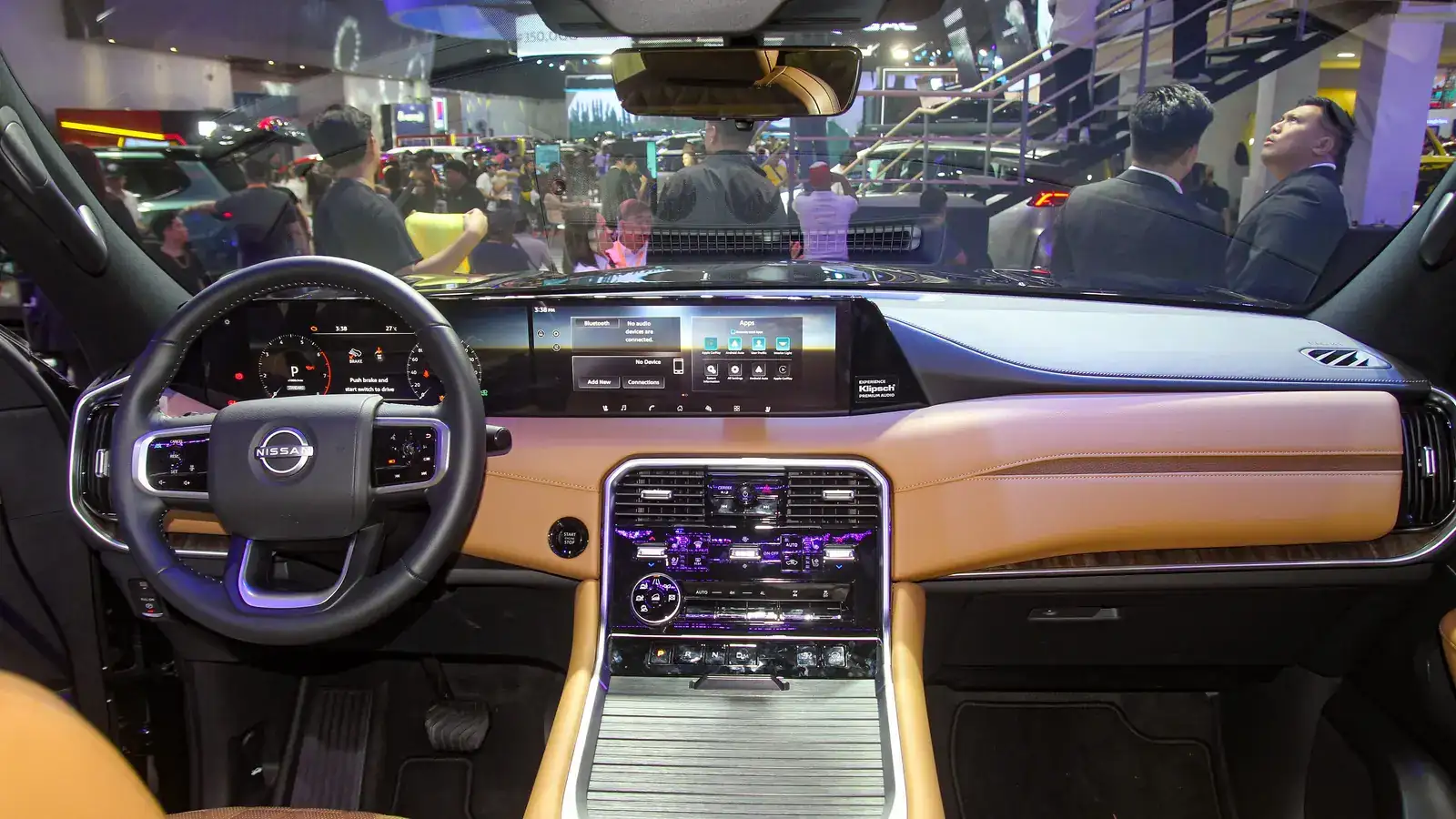
The Y63 Patrol is sold in Australia as a six-rung ladder — Ti, Ti+, Ti-L, Ti-L+, PRO-4X and Ti-L Reserve — and every rung uses the same engine, the same gearbox and the same four-wheel-drive hardware. What separates them is suspension, wheels, screens and trim. For an importer that matters more than it sounds, because two of those four things change what the car costs to run in your market, and one of them changes what it costs to land.
The short version
- Every grade has the same drivetrain. A 3.5-litre twin-turbo V6, 317 kW and 700 Nm, a nine-speed automatic and four-wheel drive with a dual-range transfer case, from the Ti upwards.
- The Ti already has the off-road hardware. Paying up the ladder adds comfort, screens and suspension sophistication, not capability.
- Wheel size is the decision that follows you. 18-inch wheels on the Ti, 22-inch on the Ti-L Reserve — and tyre cost and availability differ enormously by market.
- Air suspension is a serviceability question. On the PRO-4X and Ti-L Reserve it is a genuine capability upgrade and a long-term maintenance liability, in that order.
- Each rung costs more than its list difference once duty and consumption tax are applied to a higher CIF value.
The six grades at a glance
| Grade | What it adds | A$ MSRP, before on-road costs |
|---|---|---|
| Ti | Dual 12.3-inch displays, 3D Around View Monitor, Google built-in, tri-zone climate, ProPILOT, 18-inch wheels, dual-range 4WD | 98,990 |
| Ti+ | Panoramic sunroof, power tailgate, privacy glass, roof rails, intelligent rear-view mirror, rain-sensing wipers | 109,480 |
| Ti-L | Dual 14.3-inch displays, 12-speaker Klipsch audio, head-up display, e-Damper suspension, 20-inch wheels | 122,690 |
| Ti-L+ | Genuine leather, heated and ventilated front seats, massaging driver's seat, heated steering wheel, cool box, biometric cooling, ambient lighting | 134,690 |
| PRO-4X | Adaptive air suspension, black alloys on all-terrain tyres, off-road bumper, trailer docking support, electric brake controller | 137,590 |
| Ti-L Reserve | Adaptive air suspension, 22-inch wheels, dual 12.8-inch rear screens, massage seats for both front occupants | 145,990 |
Australian grades and prices as announced by Nissan Australia on 27 August 2026, before on-road costs. Grade structure and pricing differ by market — the Australian ladder is not the Japanese, Gulf or New Zealand one.
What actually changes as you go up
Nothing mechanical, until the suspension
The Ti carries the full four-wheel-drive system, the dual-range transfer case, the terrain modes and the electronic locking rear differential. A buyer choosing the Ti is not choosing a lesser off-road vehicle; they are choosing a less decorated one.
The first genuine mechanical step is the Ti-L’s e-Damper electric shock absorber, and the second is adaptive air suspension on the PRO-4X and Ti-L Reserve. Air suspension changes ride height, ride quality and, on the PRO-4X, articulation on rough ground. It also adds compressors, air springs and height sensors to a vehicle that may spend its life a long way from a Nissan dealer.
The honest view on air suspension
If the car is going to a market with a franchised Nissan network and a parts supply, air suspension is a straightforward upgrade. If it is going somewhere it will be maintained by an independent workshop, ask what a replacement air spring costs and how long one takes to arrive before you pay for the feature. That answer is the deciding factor far more often than the driving impression is.
Screens and audio
The Ti and Ti+ run dual 12.3-inch displays; the Ti-L and above run dual 14.3-inch displays with a head-up display and 12-speaker Klipsch audio. The Ti-L Reserve adds two 12.8-inch screens for the second row. These are the features that photograph well and the ones a used buyer values least three years later, which is worth knowing if you are importing for resale rather than for yourself.
Wheels, and why they matter more than the badge
Eighteen inches on the Ti, twenty on the Ti-L, twenty-two on the Ti-L Reserve, and all-terrain tyres on black alloys for the PRO-4X. In a market with good roads and a well-stocked tyre trade, this is a styling choice. In a market where the car will see gravel, potholes or long distances between towns, it is a running-cost and availability decision: larger wheels mean thinner sidewalls, more damage, more expensive replacements and, in some markets, a genuine wait for stock in the correct size.
Why each rung costs more than the price list says
The gap between the Ti and the Ti-L Reserve is A$47,000 on the Australian list. In your own market it is more than that, because the higher price raises the CIF value that your duty is assessed on, and in most regimes your consumption tax is then charged on the duty-inclusive value — so the extra car is taxed, and the tax on it is taxed.
The arithmetic, using round numbers purely to show the mechanism and not as anyone’s actual rates: on a duty of 10% and a consumption tax of 20% charged on the duty-inclusive value, every extra A$1,000 of vehicle value becomes A$1,320 landed. Apply that to a A$47,000 gap and the ladder is A$62,000 wide by the time the car is registered. Your real multiplier depends entirely on your own market’s rates, which is why the calculation is worth doing before you pick a grade rather than after.
Where a market bands its tax by price rather than applying a flat percentage, the effect is sharper still: a single rung can push the car over a threshold and into a higher band, which is a step change rather than a slope. Model the landed figure for at least two grades before you commit — the Ireland cost calculator does this for an Irish landing, and the same principle applies everywhere.
Which grade to actually import
- Towing and touring: the Ti or the PRO-4X. The Ti because the tow rating and the four-wheel-drive hardware are already there at the bottom of the range; the PRO-4X because the all-terrain tyres, off-road bumper and trailer-docking hardware are genuinely aimed at the job.
- Family transport on sealed roads: the Ti-L. It is where the bigger screens, the head-up display and the e-Damper suspension arrive, and it stops short of the features that cost the most to maintain.
- Chauffeur and executive use: the Ti-L+ or the Ti-L Reserve, and the Reserve only if the second-row screens will actually be used. They are the single largest price step for the narrowest benefit.
- Resale in a market with no Y63 history: the middle of the range. The bottom rung competes with every other large SUV on price, and the top rung has the thinnest second-hand audience of the six.
The ladder is not the same everywhere
The six grades above are the Australian range. Other markets get different names, different equipment and, in some cases, a different engine — a 3.8-litre naturally aspirated V6 is offered alongside the 3.5-litre twin-turbo in parts of the world. New Zealand’s grade structure had not been published at the time of writing, and the Gulf range is left-hand drive throughout.
The practical rule is the same as for any import: import against a chassis number and a specification document, not against a grade name. Two cars badged Ti-L in two markets are not necessarily the same car. The wider process is in our guide to importing a Nissan Patrol, and the source-market comparison in the best cars to import from Australia.
Grade structures, equipment levels and prices are set by each market’s distributor and change without notice. The Australian prices above are as announced on 27 August 2026, before on-road costs, and are not a quote. The duty and tax arithmetic in this guide is an illustration of a mechanism using round numbers — it is not any market’s rate. Verify rates with the revenue or customs authority in your destination before committing.