
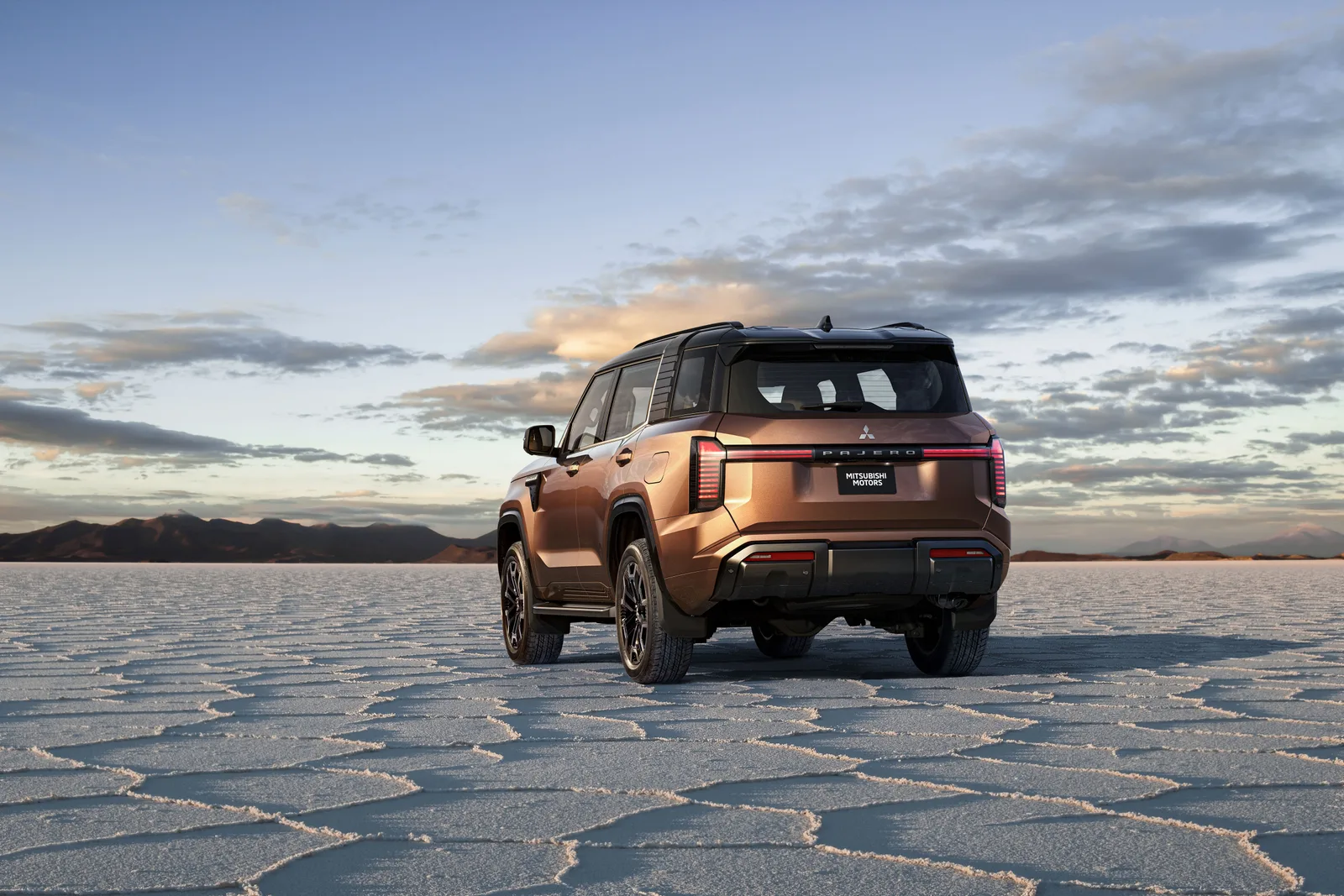
Mitsubishi builds the all-new Pajero in Thailand and sells it there first. Japan and Australia follow inside the same fiscal year, and Australia is the only one of the three with a published grade structure — four grades across six variants, from Australian government approval documents. For a dealer outside those markets, Thailand and Australia are the two corridors that can actually be bought today, and they are not interchangeable. This is what each one will contain once a price exists, why Japan is not yet a third option, and why committing floor-plan before then is the wrong trade.
The short version
- Thailand builds it and sells it first. A Thai domestic price will carry Thai vehicle excise — an ad valorem charge calculated on the suggested retail price — plus VAT. Neither belongs in your CIF base. We are not publishing the rates, because we could not verify them against the Thai authorities.
- Australia is a retail corridor, not a factory one. An Australian list price carries 10% GST and excludes all on-road costs. It is the more transparent of the two prices and the further of the two from the plant.
- Australia is the only market with a published range structure. GLX, GLS, Exceed and GSR across six variants, per approval documents reported by carsales — GLX five-seat, GLS and Exceed in both five and seven, GSR seven-seat.
- Thai export capacity is under pressure. The Federation of Thai Industries cut Thailand’s 2026 export production forecast from 950,000 to 900,000 vehicles on 1 August 2026, with exports to the Middle East down 38.35% in the first half after the Strait of Hormuz closure.
- Neither corridor can be priced yet. Mitsubishi has published no price in either country. A dealer committing capital today is committing it to an unknown unit cost against an unknown residual.
What a Thai price will contain
Thailand is where the Pajero is built, and Mitsubishi has said the Thai market gets it first. That makes Thailand the shortest possible route from plant to ship, and it makes the Thai domestic list price the first number the world will see. It is also the number most likely to be misused.
Thailand levies excise tax on motor vehicles as an ad valorem charge calculated on the suggested retail price rather than on an ex-works value, with value-added tax sitting on top and exports zero-rated for VAT. That structure is what matters here, and it is the part we can state. We are not publishing the rates. The Thai Excise Department’s motor-vehicle schedule was not reachable when we checked on 2 September 2026, and a tax figure that rests on a professional summary rather than the authority is exactly the kind of number this desk declines to print. Get the current excise band for this model from the Excise Department, and the VAT position from the Revenue Department, before you build a landed cost on either.
The consequence is simple and it is where most people get Thailand wrong. A Thai showroom price for a large diesel SUV is a tax-inclusive domestic retail figure, and the excise inside it is assessed on that retail figure itself. Treating it as an export base overstates your cost, sometimes substantially. What you need from a Thai supplier is a written FOB or ex-works figure, not a discount off the showroom price, and confirmation in writing of how excise is treated on the export sale. That is a question for the Thai Excise Department and your exporter, and it is not one to settle on an assumption.
No Thai excise or VAT rate is stated above, because we could not verify one against the Thai Excise Department or Revenue Department on 2 September 2026. The treatment of excise on an export sale of this model has not been verified either. Confirm both with the authority or your customs broker before committing funds. Import and registration taxes at the destination are charged to the registered owner, so they are paid in the buyer’s name.
Why Japan is not yet a third corridor
Japan gets the Pajero inside the same fiscal year and is the largest of the seven source markets we buy in, so the question is fair. The answer is timing and stock. Mitsubishi has not said where inside fiscal 2026 the Japanese launch falls, only that it follows Thailand, and a just-launched model has no used-auction stock behind it — which is the mechanism that makes Japan cheap. A Japanese car at launch means a domestic new-vehicle order competing with domestic allocation, not a bid on an auction floor. Japan becomes a real third corridor once cars start reaching the auction halls, and we will price it then. Until then, naming it as an option would be selling you a route that does not exist.
What an Australian price will contain
Australia is a retail market for this car, not a production one, so the Australian corridor buys a finished domestic unit at domestic retail. The offsetting advantage is that Australian pricing is unusually legible: a manufacturer’s list price carries 10% GST inside it and excludes registration, stamp duty and compulsory third-party insurance entirely. Those on-road costs are an Australian buyer’s problem and never yours.
A sale of goods can be GST-free where the supplier exports them within 60 days of the earlier of receiving payment or issuing an invoice, on the Australian Taxation Office’s conditions and with its documentary evidence of export, per the ATO’s “Exports and GST” guidance, checked 2 September 2026. That is a real and usable 10% step, and it is the single largest reason an Australian-sourced car can compete with a factory-market one.
What we are not telling you about Australian tax
Australia also levies Luxury Car Tax above a threshold the ATO revises annually. We could not verify the 2026–27 threshold from the ATO directly at the time of writing, and Mitsubishi has published no Australian price for the Pajero, so we do not know whether this car is caught by it at all. We are therefore publishing no LCT figure and making no assumption that it comes out on export. Get the dealer’s written position on both GST and LCT before you commit, and budget for the worse answer until it is in writing.
For scale, the last Pajero Sport 4WDs to reach Australia were listed by CarsGuide at A$51,540 to A$65,590 plus on-road costs in 2025. The new Pajero is a larger, more heavily equipped car entering the segment occupied by the Toyota Prado and the Ford Everest, so it is reasonable to expect it above that band. That is an expectation, not a price, and it is not a basis for a purchase order.
Australian GST and the 60-day export condition above are taken from the Australian Taxation Office and were checked on 2 September 2026. No Luxury Car Tax rate or threshold is stated, because we did not verify the 2026–27 figures against the ATO. Rates and thresholds change annually. Confirm the current position with the ATO or your accountant before committing funds, and note that import and registration taxes at the destination are charged to the registered owner rather than to us.
Which currency each corridor puts you in
The two corridors are two different currency exposures, and a dealer outside Australia and Thailand pays in neither. The hammer price in the Australian corridor is AUD; in the Thai corridor it is THB. Both are source currencies, which means the same rule applies to each: if it weakens against the money you hold, the car gets cheaper, and nothing about the car has changed. Ocean freight and marine insurance are usually invoiced in US dollars, so that leg tracks your currency against the dollar rather than against the seller’s.
The A$51,540 to A$65,590 figures above are Australian dollars, and they are the outgoing Pajero Sport rather than this car. We are not quoting an AUD or THB level against any destination currency here, because an undated rate is worthless within a week and we have no price to apply one to. Two mechanics are worth carrying into the decision anyway. Duty and consumption tax at your port are assessed at your customs authority’s published conversion rate, which in most regimes is fixed for a period rather than tracking spot — so a favourable move on your banking app does not reduce this month’s tax bill. And the rate moves between the day a corridor is quoted and the day the car is paid for, which is a real risk that sits with the buyer.
The two corridors, side by side
| Thailand | Australia | |
|---|---|---|
| Role in this launch | Builds it, and sells it first | Third launch market, inside fiscal 2026 |
| Tax inside the domestic price | Vehicle excise, ad valorem on suggested retail price, plus VAT — rates not verified, so not stated | 10% GST; no on-road costs included |
| Export tax step | Exports zero-rated for VAT; excise treatment on export to be confirmed with the exporter | GST-free where exported within 60 days on the ATO's conditions; LCT position unverified |
| Range structure published | Not published | GLX, GLS, Exceed, GSR — six variants, from approval documents |
| Steering | Right-hand drive | Right-hand drive |
| Known supply pressure | FTI cut the 2026 export production forecast to 900,000 units on 1 August 2026 | None specific to this model; volume is allocation from Thailand |
| Price published | No | No |
Sources: Mitsubishi Motors Corporation (launch sequence and build location, 2 September 2026); Australian Taxation Office, checked 2 September 2026 (GST and the GST-free export conditions); carsales, citing Australian government approval documents (the Australian range); The Nation Thailand, 1 August 2026, reporting the Federation of Thai Industries. Thai excise and VAT rates are deliberately not stated — see the Thailand section. No price has been published in either market.
Is the car admissible either way?
Both corridors ship a right-hand-drive vehicle, so neither creates a steering problem in any of our destination markets. Because this is a new vehicle, the age limits that restrict used imports in Kenya, Sri Lanka and much of the Caribbean do not apply to it. What does apply is type approval and compliance, and that is a destination question rather than a corridor question — the answer is the same whether the car leaves Laem Chabang or Melbourne. In Ireland and the United Kingdom, where the Pajero is not sold, it means individual approval, and no CO₂ figure has been published for the model. We set the admissibility position out in full in our report on the reveal. Confirm the current rule with the destination authority before you commit to either route.
The freight risk that is already in the numbers
Thailand exports roughly two-thirds of everything it builds, and 2026 has not been a good year for it. On 1 August 2026 the Federation of Thai Industries cut the country’s full-year production target from 1.5 million vehicles to 1.45 million, with the reduction falling entirely on export production — from 950,000 units to 900,000, a cut of 5.26% — while the domestic forecast of 550,000 was left unchanged. First-half production was 717,212 units, down 1.04% on the same period in 2025.
1.45m
Thai 2026 production target, cut from 1.5m
900,000
Export production forecast, cut from 950,000
−38.35%
Thai exports to the Middle East, first half 2026
717,212
Thai vehicles produced, first half 2026
The Middle East line is the one that should concern anyone routing out of Laem Chabang. Thai vehicle exports to the region fell 38.35% in the first half of 2026 against the same period a year earlier, with the closure of shipping routes through the Strait of Hormuz continuing to disrupt deliveries. Surapong Paisitpatanapong, adviser to the club chairman and spokesman for the Automotive Industry Club, attributed the target cut to global economic uncertainty, the Middle East war, trade barriers and competition in the electric-vehicle market.
A corridor is not just a price. It is a price, a sailing schedule and a route that is currently open — and one of those three is under active disruption.
For a dealer in East Africa, the Gulf or South Asia, that is a live variable in the Thai corridor and not in the Australian one. It does not make Thailand the wrong answer. It makes lead time a thing you confirm per sailing rather than assume from a schedule, and it is a reason to price the Australian route even if you expect to buy Thai.
Which corridor should a dealer commit to?
On what is published today, the honest answer is neither, yet. What can be said is how the decision will break once prices exist.
- Thailand should win on unit cost if the exporter can quote a clean FOB figure with the excise position confirmed in writing. It is the plant, it is first in the queue, and the freight leg to East Africa, South Asia and the Caribbean is shorter than from Australia.
- Australia should win on certainty. The grade structure is already visible, the tax inside the price is a single legible 10%, and an Australian retail invoice is a document every destination customs authority has seen before.
- Australia is the better first unit. If you are landing one car to learn the model — the paperwork, the parts position, what your market makes of it — buy the corridor with the fewest unknowns and take the cost penalty once.
- Thailand is the better tenth unit, on the assumption that the FOB number lands where it should. Volume is where the excise question stops being a curiosity and starts being the whole margin.
- Specification will differ, and you should ask. Mitsubishi footnotes both a 14.3-inch and a 12.3-inch display, and both 480 Nm and 470 Nm “on select specifications”. Nobody has published which market gets which. Do not assume the Thai car and the Australian car are the same car.
The case for not buying this yet
We source cars for a living and we would still tell you to wait, for three reasons that have nothing to do with the car being any good.
There is no price. A floor-plan decision on an unpriced unit is not a decision, it is a position. Mitsubishi has to publish Thai and Australian pricing within months, and the cost of waiting is a few weeks in a queue.
There is no residual history. The Pajero nameplate was discontinued in overseas markets in 2021 and this is its first return in five years. A five-year gap means no recent depreciation curve in any of our destination markets. Dealers buy on exit value, and the exit value here is genuinely unknown — not conservatively estimated, unknown.
Official supply is coming behind you. Mitsubishi plans to launch the Pajero in approximately 100 countries from fiscal 2027, which begins in April 2027. If your market is on that list, stock you land in early 2027 competes with franchised cars carrying a local warranty within months of arriving. That is the specific scenario in which an import proposition stops working, and it is worth establishing which side of it you are on before you commit capital rather than after.
The full specification, the launch sequence and the figures Mitsubishi did and did not publish are set out in our report on the reveal. For how the two corridors work in practice beyond this model, our guides to buying out of Thailand and the cost of importing from Australia cover the documentation and the freight legs, and the Ireland cost calculator models the full duty and tax stack for an Irish landing once a purchase price exists.
On the record
- The Pajero is built at Mitsubishi’s production base in Thailand and launches in Thailand first, then Japan and Australia during fiscal 2026, then approximately 100 countries from fiscal 2027 — Mitsubishi Motors Corporation, 2 September 2026.
- Australian GST is 10% and a sale of goods can be GST-free where it is exported within 60 days of the earlier of payment or invoice — Australian Taxation Office, checked 2 September 2026.
- The Federation of Thai Industries cut Thailand’s 2026 production target to 1.45 million and its export production forecast to 900,000, with Middle East exports down 38.35% in the first half — The Nation Thailand, 1 August 2026.
- Four Australian grades across six variants — GLX, GLS, Exceed, GSR — reported by carsales from Australian government approval documents.
Still not established
- Every price. Thai, Japanese and Australian pricing are all unpublished, which means no landed cost for this model exists yet in either corridor.
- Thai excise treatment on an export sale of this model. Not verified with the Thai Excise Department, and not assumed away in anything above.
- Australian Luxury Car Tax. The 2026–27 threshold was not verified from the ATO at the time of writing and no Australian price exists to test against it.
- Which market gets which specification. Mitsubishi footnotes two display sizes and two torque figures without saying where each applies.
- Warranty terms in either corridor, and whether any of them travel with an exported car. This is usually the largest undisclosed variable in a launch and it is undisclosed here.
The one-line version
A dealer in a right-hand-drive market should read this because the Pajero is only buyable out of Thailand or Australia until April 2027, which makes the corridor choice the whole margin decision.
Pricing both corridors when the numbers land
Thailand and Australia are both countries our own team buys in, so we can quote the same Pajero out of either and show you the two landed figures side by side rather than one. Register a grade and a destination and we will run both the day Mitsubishi publishes a price — or tell us the units you need and we will model it at volume. If the answer comes back that official supply beats the import in your market, we will tell you that instead.
Sources
- Mitsubishi Motors Unveils the All-New Pajero Cross-Country SUV — Mitsubishi Motors Corporation
- The Revenue Department of Thailand — value added tax — Revenue Department of Thailand
- Exports and GST — Australian Taxation Office
- Thailand cuts 2026 car output target as exports weaken — The Nation Thailand
- 2027 Mitsubishi Pajero range leaked — carsales
- 2026 Mitsubishi Pajero 4WD revealed, including engine and towing capacity — CarsGuide