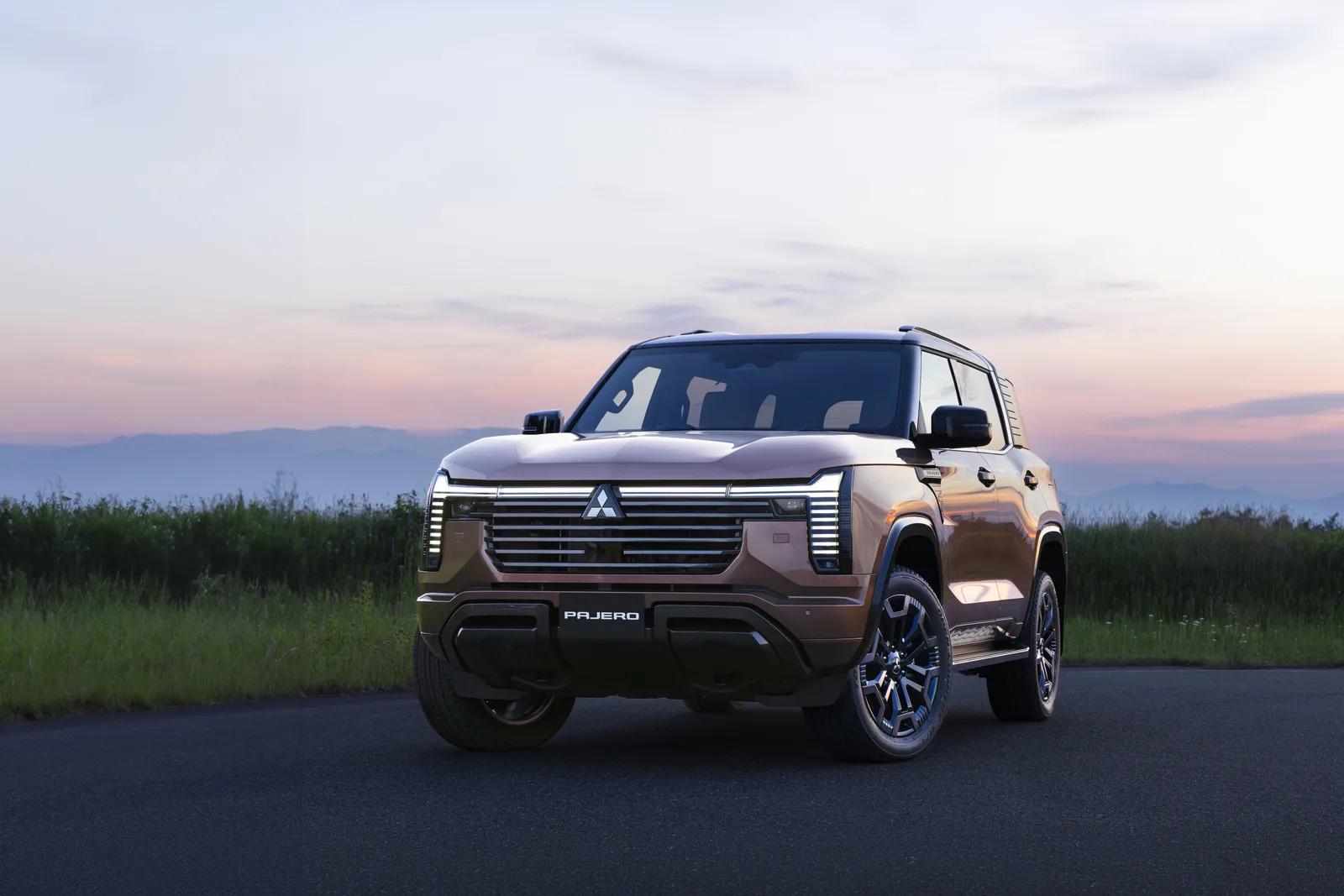
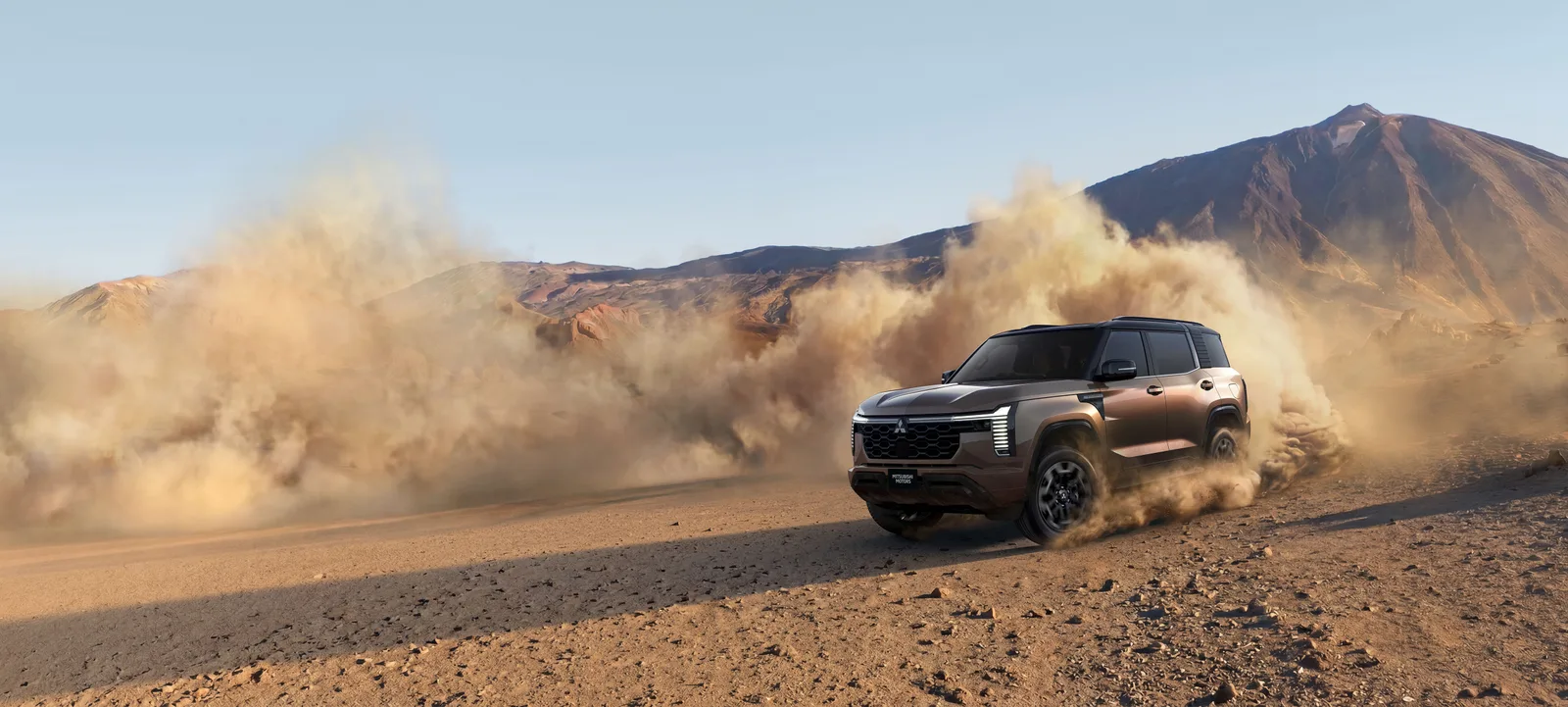
Mitsubishi Motors revealed the all-new Pajero on 2 September 2026. It is a ladder-frame, seven-seat cross-country SUV built at the company’s plant in Thailand, running a 2.4-litre clean diesel with a single variable-geometry turbocharger, 480 Nm and an eight-speed automatic. Thailand gets it first, then Japan and Australia inside fiscal 2026, then around 100 further countries from fiscal 2027. Mitsubishi published the specification, the dimensions and the launch order. It published no price, in any market, and no power output. Both of those omissions matter more to an importer than anything that was announced.
The short version
- The all-new Pajero is built in Thailand, on a ladder frame derived from the Mitsubishi Triton, and launches in Thailand first, followed by Japan and Australia during fiscal 2026 — April 2026 to March 2027 on Mitsubishi’s calendar.
- Around 100 further countries follow from fiscal 2027 onward, which begins in April 2027. Outside Thailand, Japan and Australia, there is no official car before then. That single sentence is the whole import story.
- The engine is a 2.4-litre clean diesel with a single wide-range variable geometry turbocharger — not the Triton’s twin-turbo, which a great deal of pre-reveal coverage still says and which is now wrong. Torque is 480 Nm, or 470 Nm on select specifications.
- Mitsubishi has not published a price in any market. Not Thailand, not Japan, not Australia. Any landed-cost figure you are shown for this car today is built on a purchase price nobody has.
- Mitsubishi has not published a power output either. The 150 kW and 3,500 kg braked towing figures now circulating come from CarsGuide’s reporting, not from Mitsubishi’s release.
What Mitsubishi actually confirmed
The world-premiere release is unusually complete on hardware and unusually silent on commerce. Mitsubishi gave dimensions to the millimetre, approach and departure angles to one decimal place, the drivetrain architecture, the seating mechanism and the audio brand. It gave no price, no power figure and no towing rating.
2.4 L
Clean diesel, single VGT
480 Nm
470 Nm on select specifications
8-speed
Automatic with sport mode
230 mm
Ground clearance
7 seats
Three-row layout
Thailand
Where it is built
| Measure | Figure |
|---|---|
| Length | 4,920 mm |
| Width | 1,925 mm |
| Height | 1,910 mm |
| Wheelbase | 2,870 mm |
| Track, front and rear | 1,630 mm |
| Ground clearance | 230 mm |
| Approach angle | 30.4 degrees |
| Ramp breakover angle | 22.6 degrees |
| Departure angle | 25.8 degrees |
| Weight distribution | 52:48 front to rear |
Source: Mitsubishi Motors Corporation, 'Mitsubishi Motors Unveils the All-New Pajero Cross-Country SUV', 2 September 2026. Mitsubishi footnotes that figures apply to vehicles equipped with 20-inch tyres.
The four-wheel-drive system is Super Select 4WD-II — 2H, 4H, 4HLc and 4LLc — integrated with Super-All Wheel Control and Active Yaw Control, with seven drive modes named as Normal, Eco, Gravel, Snow, Mud, Sand and Rock. The frame is derived from the Triton pickup, with a double-wishbone front end and a newly developed five-link rigid rear axle. The second row slides 150 mm and tumbles; the third row folds flat.
Inside, a monolithic display integrates two 14.3-inch screens, dropping to 12.3-inch on select specifications. Mitsubishi fits eight airbags, including what it says is its first SRS centre airbag, three-zone climate control with seat ventilation, MI-PILOT highway assistance and Emergency Lane Assist. The audio is a 12-speaker system developed with Yamaha. The instrument display reworks the Pajero’s triple-gauge layout and shows altitude, compass, pitch and roll.
The two numbers everyone is quoting that Mitsubishi did not publish
Two figures are being repeated as though they came from the manufacturer. They did not. 150 kW and a 3,500 kg braked towing capacity both come from CarsGuide’s reporting on the reveal. Mitsubishi’s own release states torque and says nothing at all about power or towing.
That is not a reason to disbelieve either number. 150 kW is what the Triton’s 2.4-litre diesel produces, and 480 Nm is 10 Nm more than the Triton’s 470 Nm, which also explains the “470 Nm on select specifications” footnote — some markets appear to get the Triton’s tune. It is a reason to attribute them correctly. If you are a dealer sizing a towing proposition against a Ford Everest or a Toyota Prado, the difference between “Mitsubishi rates it at 3,500 kg” and “CarsGuide reports 3,500 kg” is the difference between a specification and a report of one.
The correction worth making
A large amount of pre-reveal coverage — still live, still indexed — describes this car as having a 2.4-litre bi-turbo diesel with 150 kW and 470 Nm, matched to a six-speed automatic. Mitsubishi’s release says a single wide-range variable geometry turbocharger, 480 Nm, and a newly developed eight-speed automatic. Two of those three details changed at the reveal. If a quote you are given cites a six-speed gearbox, it was written before 2 September 2026.
Why the launch order is the story
Mitsubishi’s sequencing is precise, and it is the part of the release with the most commercial consequence.
2 September 2026
World premiere
Mitsubishi Motors reveals the all-new Pajero from Tokyo. Specification, dimensions and launch markets are published. No pricing, in any market.Fiscal 2026
Thailand, then Japan and Australia
Mitsubishi states the model launches in Thailand first, followed by Japan and Australia, all during fiscal 2026 — which the company defines as April 2026 to March 2027. Australian trade press reports a local arrival before the end of 2026.Fiscal 2027 onward
Approximately 100 countries
Mitsubishi plans to launch the Pajero in around 100 countries, naming ASEAN, Latin America and the Middle East. Mitsubishi's fiscal 2027 begins in April 2027, so this is the earliest an official car reaches most of the world.
Read that as a buyer rather than as an enthusiast. If you are in Kenya, Jamaica, Mauritius, New Zealand or Sri Lanka, the Pajero is not a 2026 car for you through the official channel. It is a fiscal-2027 car at the earliest, and “approximately 100 countries” is not a commitment that yours is one of them. The only way a Pajero reaches those markets before then is out of a market that already has it — which, for the whole of fiscal 2026, means Thailand, Japan or Australia.
Mitsubishi has told you exactly which three countries will have this car first. For everyone else, the launch calendar is a sourcing problem, not a waiting problem.
We have set out what each of those corridors actually involves — what a Thai domestic price contains, what an Australian one contains, and which one is likely to reach a port first — in our read on the Thailand and Australia corridors.
Does this apply to you, and is it legal to import?
It applies to you if you buy or sell right-hand-drive SUVs. All three first-launch markets — Thailand, Japan and Australia — are right-hand drive, so the Pajero arrives in the hand most of our destinations register. Mitsubishi names Latin America and the Middle East in the later rollout, which implies a left-hand-drive car exists, but the company has not confirmed one.
On admissibility, the useful point is that this is a new vehicle. The age limits that govern used imports in Kenya, Sri Lanka and much of the Caribbean do not bite on a zero-kilometre car. What replaces them is type approval. In markets where Mitsubishi will sell the Pajero officially, a privately imported example inherits nothing from that: it is still an individual import, assessed individually. In Ireland and the United Kingdom, where the Pajero is not currently sold, registration means individual approval rather than a certificate of conformity — and there is no published CO₂ figure yet, so Irish Vehicle Registration Tax cannot be calculated at all. The mechanism is set out in our VRT guide.
Verify the current position with the destination authority rather than with us: the Kenya Bureau of Standards and the Kenya Revenue Authority for Kenya, NZTA for New Zealand, Revenue and the NSAI for Ireland, and the national customs authority for the Caribbean markets.
What can anyone honestly tell you it lands at?
Nothing, yet, and anyone who gives you a figure is guessing at the largest input. A landed cost is built from a purchase price, inland transport, ocean freight, marine insurance, duty and consumption tax. Five of those six can be estimated today. The purchase price cannot, because it does not exist in any market.
There is a second trap waiting behind the first. When Thai and Australian prices do appear, they will be domestic retail prices with domestic taxes inside them, and neither is a CIF base. Thailand levies excise tax on motor vehicles as an ad valorem charge calculated on the suggested retail price rather than on an ex-works value, with value-added tax on top; we are not publishing the Thai rates, because the Excise Department’s motor-vehicle schedule was not reachable when we checked on 2 September 2026. Australia’s list prices carry 10% GST and exclude all on-road costs, per the Australian Taxation Office, checked 2 September 2026. Subtracting a landed cost from a domestic list price, in either country, produces a number that means nothing.
No Thai excise or VAT rate is stated above, because we could not verify one against the Thai Excise Department or Revenue Department on 2 September 2026. The Australian GST position is the ATO’s, checked the same day, and no Luxury Car Tax figure is stated. Tax and duty positions change. Confirm the current rate and its treatment on an export sale with the relevant authority, or with your customs broker, before you commit money. Providence does not pay import or registration taxes on a customer’s behalf — they are charged to the registered owner.
If you want to see how the whole stack behaves for a specific destination once a price exists, the Ireland cost calculator models it end to end for an Irish landing, and our guides to importing from Thailand and importing from Australia set out the two corridors this car will actually come out of.
Should you move now or wait?
- If you want the car and live in Thailand, Japan or Australia: wait for local pricing, which is the next thing Mitsubishi has to publish. There is nothing to commit to until then.
- If you are importing into a market not in the first three: registering interest now costs nothing and puts you in a queue that will form quickly. Committing a deposit against an unpublished price does not.
- If you are a dealer: the decision is not about this car, it is about the fiscal-2027 rollout. If your market is inside the approximately-100 list, official supply arrives from April 2027 and competes with anything you land before it. If it is outside, the import route is the only route and the window is longer.
- If you are in Ireland or the United Kingdom: wait, and be prepared to wait indefinitely. Without a published CO₂ figure and a settled individual-approval path, a quote for this car in either market is arithmetic performed on a blank.
What the nameplate brings with it
The Pajero was introduced in 1982 and sold in more than 170 countries and regions, with production across four generations exceeding 3.29 million units, on Mitsubishi’s own figures. It was discontinued in overseas markets in 2021, which makes this the first return to the global market in five years.
Mitsubishi cites 12 Dakar Rally victories including seven consecutive wins, and that record survives checking — the seven-in-a-row run was 2001 to 2007, and neither figure has been beaten. It is one of the rare occasions where a manufacturer’s heritage claim is exactly as strong as stated. What it does not tell you is what the car is worth in three years in your market, because a nameplate absent for five years has no recent residual history anywhere. A dealer should price that uncertainty in rather than assume the badge carries it.
On the record
- The specification, dimensions, angles, drivetrain and equipment above, all from Mitsubishi Motors Corporation’s world-premiere release of 2 September 2026.
- Built at Mitsubishi’s production base in Thailand, launching in Thailand first, then Japan and Australia during fiscal 2026, then approximately 100 countries from fiscal 2027 onward.
- A single wide-range variable geometry turbocharger, 480 Nm (470 Nm on select specifications), and a newly developed eight-speed automatic.
- Twelve Dakar Rally victories including seven consecutive wins, from 2001 to 2007 — verified against the record rather than repeated.
Still not established
- Price, in every market. Mitsubishi has published none. Thai, Japanese and Australian pricing are all outstanding.
- Maximum power. Absent from Mitsubishi’s release. The 150 kW in circulation is CarsGuide’s reporting.
- Braked towing capacity. Absent from Mitsubishi’s release. The 3,500 kg figure is CarsGuide’s.
- Fuel consumption, CO₂ and emissions compliance. Not published, which is what makes registration tax uncomputable in any CO₂-banded market.
- Grade equipment levels. Australian approval documents show four grades across six variants; what separates them has not been published by Mitsubishi.
- Whether Mitsubishi calls this the fifth generation. The release says “all-new” and counts four prior generations. We have not put the phrase in its mouth.
The one-line version
A private importer or dealer in a right-hand-drive market should read this because the Pajero’s launch order confines the car to Thailand, Japan and Australia until April 2027, which makes it a sourcing decision rather than a showroom one.
Registering a specification rather than an enquiry
Our Mitsubishi Pajero page carries the confirmed specification and the Australian grade structure, so you can register interest against a grade and a destination rather than a general enquiry. Thailand and Australia are both countries our own team buys in — tell us where the car is going and we will model the landed figure the day a price is published, and tell you plainly if the answer is that it does not work.
Sources
- Mitsubishi Motors Unveils the All-New Pajero Cross-Country SUV — Mitsubishi Motors Corporation
- Mitsubishi Motors To Debut the All-New Pajero Cross-Country SUV in Autumn 2026 — Mitsubishi Motors Corporation
- 2026 Mitsubishi Pajero 4WD revealed, including engine and towing capacity — CarsGuide
- 2027 Mitsubishi Pajero range leaked — carsales
- Dakar Rally — Mitsubishi Motors motorsports history — Mitsubishi Motors Corporation
- The Revenue Department of Thailand — value added tax — Revenue Department of Thailand